WILLIAM HOWARD TAFT

Taft, the incumbent President, was in a 3 way race against Theodore Roosevelt and Woodrow Wilson. He came in third.

The practice became extensively used and the phrase along with it during the William Howard Taft administration where the media popularized it.

President Jimmy Carter had invoked the Taft-Hartley Labor Law, which forced the striking workers to go back to work for a 100 day “cooling off” period.

She accompanied William Howard Taft at his inauguration from the Capitol to the White House—what we call the ‘Inaugural Parade’. No first lady had ever done that, and there was much criticism. However, she was a staunch feminist and so was the new President—see {639924} .

Note that the President left Taft, then the Secretary of War, as the acting President and NOT the Secretary of State who many people erroneously think is the senior member of the cabinet, nor the Vice President. Roosevelt just put in charge the man he was most comfortable with. Interestingly, neither the Vice President or the Secretary of State objected or were disappointed. It was generally acknowledged that Taft was the best and strongest leader in the cabinet and that he was as close to the president as possible. See {640479} for a cartoon quotation that was created about Taft’s assignment.

Taft was Roosevelt’s hand-picked successor, but Taft did not live up to Roosevelt’s expectiations.

President Theodore Roosevelt took and extended trip to the West and left William Howard Taft, then the Secretary of War, as the acting President and NOT the Secretary of State who many people erroneously think is the senior member of the cabinet, nor the Vice President. Roosevelt just put in charge the man he was most comfortable with. Interestingly, neither the Vice President or the Secretary of State objected or were disappointed. It was generally acknowledged that Taft was the best and strongest leader in the cabinet and that he was as close to the president as possible. See {639910}

Theodore Roosevelt had pledged to serve only two terms and everyone was looking to see whom he supported to succeed him in 1908. He had absolutely decided it should be William Howard Taft, his Secretary of War, and old colleague. But he didn’t want to offend the party leaders by precluding their ability to appear to have a say in the choice of nominee. So he made no public statement. But most journalists in Washington realized what the reality was and the Kansas City Times simply published this little ditty.
Taft was a jurist whose tendency was to respond to each point his opponent made and argue it logically and then to on to the next point much as in a formal debate. However, Bryan was a very dynamic speaker who was a populist and demagogue. Roosevelt who could debate logically or thunder like a demagogue was of the opinion that you should not let a demagogue control the agenda in a campaign. Trying to answer was futile. Instead attack the demagogue where he is weak and stay on the attack. This was hard for Taft to do as he was not the skilled speaker or politician that TR was. Taft won, but Roosevelt was actively campaigning for him and attacking Bryan. The notion of attack, as Theodore Roosevelt used it was NOT negative campaigning. Roosevelt did not attack Bryan personally or make ad hominum arguments. What he advocated was that when Bryan made a speech and criticized a policy that Taft supported, instead of answering him point by point, as one would do in a debating society (at which Taft excelled) attack some of the worst policies that Bryan was advocating or had advocated. Control the agenda so that Bryan would have to answer Taft’s criticism, not the other way around.

The President’s (William Howard Taft’s) wife was a college graduate and an ardent feminist who had played an active part in her husband’s affairs both as an advisor, and reviewer of speeches and other drafts as well as a public role {638463} especially in the Philippines where she was loved and admired by the populace and the elites. Shortly after her husband assumed the presidency, she had a very serious and debilitating stroke and never again served as a political advisor and confidant. There are many who correlate this with Taft’s presidency which was not very successful compared to his brilliant success at every other public position. The Tafts—unusual for the time—had always worked closely as a team, and then that ended, Taft’s public performance suffered.
She was politically very well educated and experienced as well. See {640707}.
This quotation is important for two reasons. First, this is one of the most negative attacks on an opponent in a Presidential election in all of American History—to call the opponent ‘dangerous’ to the nation. Second, it is a classic example of two close political friends and allies, after a falling out. Roosevelt had in effect made Taft President in 1908, but Roosevelt was extremely disappointed as Taft was controllable by the Republican Party bosses, who hated Roosevelt. TR then challenged the then sitting President for the Republican Presidential nomination. At that time there were 12 states that had primary elections and Roosevelt won 9 of them. La Follette won 2 and Taft only 1. The majority of the states did not then have primaries allowing the party bosses to make the decision of which candidate to support. Party leaders generally did not like Roosevelt who was a major reformer, so they voted for Taft at the convention pushing him over the top when he clearly was the less popular of all 3 candidates. Roosevelt, outraged by the party bosses overriding the will of the people, then walked out of the convention and organized his own convention and TR ran as the Progressive Party (Bull Moose Party). In the general election Roosevelt got more votes than Taft, but the two of them had split the majority Republican vote and the Democrat, Woodrow Wilson was the winner.
Taft, very progressive on racial matters, was a little too optimistic. The “intelligent” Southerners were in the small minority. Only a week after Taft made this statement, Joseph Gorden, a Negro, was lynched outside Greenwood, Mississippi.
The two politicians were amazed as they learned more and more about some of industrial leaders of the country. This is the language they used in private communications.
The American army which had occupied the Philippines before Taft was appointed Governor General was extremely racist and discriminatory towards the Philippine people. Taft and his wife invited Filipinos to the Governor’s mansion and socialized with them whereas the Army officers and men never did. See {639174}.
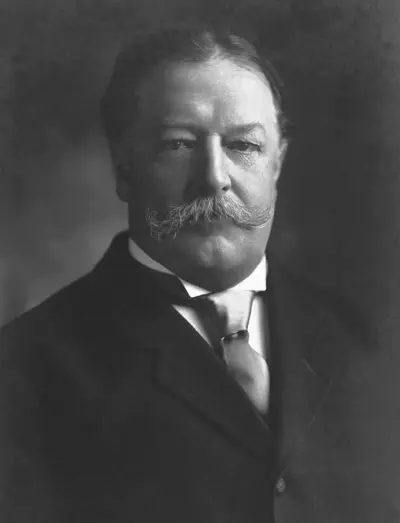
- Born: September 15, 1857
- Died: March 8, 1930
- Nationality: American
- Profession: President
William Howard Taft was the 27th president of the United States (1909–1913) and the tenth Chief Justice of the United States (1921–1930), the only person to have held both offices. Taft was elected president in 1908, the chosen successor of Theodore Roosevelt, but was defeated for reelection by Woodrow Wilson in 1912 after Roosevelt split the Republican vote by running as a third-party candidate. In 1921, President Warren G. Harding appointed Taft to be chief justice, a position he held until a month before his death.
