Dwight D. Eisenhower Quotes
Unlike presidential administrations, problems rarely have terminal dates.
Dwight D. Eisenhower, 1890-1969, 34th President of the United States (Republican, KS), Supreme Allied Commander in Europe, Annual Message to Congress, January 12, 1961
Sourced by: Eigen's Political and Historical Quotations


Canada's first female Prime Minister

He was referring to solutions for the layoff problem in American society.

The President’s party in Congress stands election every two years, so the president only has a little more than a year to get tough things done. The mayor, in contrast, had a four term and because he was a bipartisan independent representing both parties, didn’t need to campaign for his party members on the City Council. Therefore, he thought, that it was easier for him to take a controversial position and spend the time to persuade the people and build support for the position.


Hamilton thought that the Executive Branch should be co-equal with the Judicial Branch and lifetime tenure should apply to both. This quotation is very important as we consider developing countries and emerging democracies. Some in the third world have Presidents for Life—a concept that most democracies scoff at. But the stability and the independence was important enough to some of the Founding Fathers was actually advocated and considered as we formed the American Democracy.


This quotation perhaps was the most critical in Roosevelt’s political career. After winning the presidential election in his own right, that evening at a press conference he called, he not only committed to serving only two terms—then a custom and not law as it would be after WWII—but he also committed that his first three and a half years where he was not elected but assumed the presidency upon McKinley’s assassination would count as a full elected term. He therefore in 1908 could not run again even though the public wanted him to, and he might have liked another term. More important historically was 1912. Roosevelt had chosen his close friend and colleague William Howard Taft to succeed him and with Roosevelt’s support he was elected in 1908. But Taft’s wife who had always been his closest political advisor and reviewer of all his policies and speeches, had a stroke shortly after Taft was elected. Taft’s performance as President was very disappointing to Roosevelt, and he ran against Taft in the 1912 Republican nominating campaign. The very conservative Republicans were against Roosevelt, but many of those who liked him were distressed that he was reneging on his pledge not to run for a 3rd term. Roosevelt lost, and famously started the Bull Moose Party and ran against Taft and Wilson. He outpolled Taft but with the split Republican vote, Woodrow Wilson won the Presidency. This pledge haunted Roosevelt for the rest of his life.


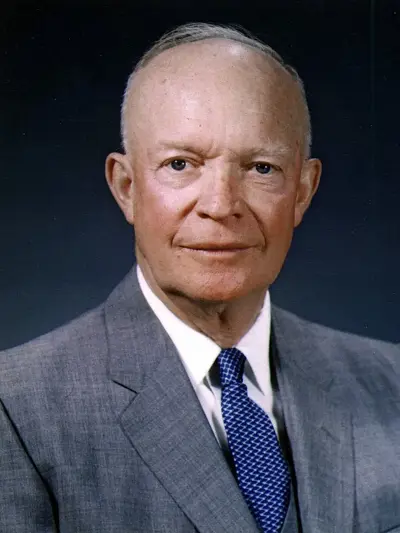
Dwight David "Ike" Eisenhower GCB OM GCS CCLH KC NPk was an American military officer and statesman who served as the 34th president of the United States from 1953 to 1961. During World War II, he became a five-star general in the Army and served as Supreme Commander of the Allied Expeditionary Force in Europe. He was responsible for planning and supervising the invasion of North Africa in Operation Torch in 1942–43 and the successful invasion of Normandy in 1944–45 from the Western Front.
