Innocent III Quotes
The perversions of heresy, which has corrupted men throughout the ages, is constantly on the increase in Toulouse. We admonish your royal serenity most carefully ... and enjoin you for the omission of sins to arm yourself strongly and powerfully to root out such degenerate shoots ... You must eliminate such harmful filth ...
Pope Innocent Iii was an interesting combination of primitive traditional Church inhumanity and intolerance for dissent and modern Christian views at the same time. Consider {45387} and {45384} for his proactive tolerance and protection of Jews and {45383} for his intolerance of Muslims and {45382} for his persecution of heretics.
Innocent III, ~1160-1216, Roman Catholic Pope, Letter to King Philip II of France, November 17, 1207
Sourced by: Eigen's Political and Historical Quotations


Lotario de' Conti

The King, a religious exremist fanatic, was a great supporter of the Inquisition whose excesses were horrible during his reign.

Luther’s attitude toward the Catholic mass was the main reason the Protestant churches abolished the mass.


While Aquinas brought much wisdom and good to the Church, this statement and others laid a foundation for murdering non-believers and organizing the Inquisition.

This statement in particular was extremely problematical. Sarbi is not just any old Mullah, but the Mufti of Jerusalem, on of the highest ranking Muslims in the World. This statement puts countries like Egypt and Jordan in a very difficult situation as the officials making treaties with the U. S. will be in effect excommunicated.

This edict gave great support to the Inquisitors of all Catholic countries. See {617572}

Michael Servetus, 1511-1553, a Spanish theologian, was tried and burned at the stake in Switzerland. John Calvin drew up the charges and pronounced the sentence. However his ill health prevented him from personally officially reading the charges. De la Fontaine did it in his stead. Most people are familiar with the charges of questioning the doctrine of the Trinity. However, before those there were a series of more civilly oriented charges of which sever are given herein. Note the emphasis on his book. It was found do offensive that it was burned along with Servetus. See related quote.

Many of the Church wanted Wycliff excommunicated, but the King and Parliament seemed to like his writing and sermons. So he was protected in his lifetime. He died at the age of 60 of a stroke. After his death the Church burned all his books that had been banned, and exhumed his body. That was burned at the stake and his ashes scattered in a river. Martin Luther did not try to reform the Church in a vacuum. There had been various critics of the Church before Luther and Wycliff was one. The last statement in this quotation was the one that really hit the then mostly corrupt clergy where it hurt.
The Church exercised the law enforcement and censorship authority in all Catholic countries. Note the offense of saying anything which is “offensive to pious ears”. The particular example that “offended” the pious was that a heretic should not be executed. These were the cultural values of the day.

The King, a religious fanatic, was a great supporter of the Inquisition whose excesses were even more horrible during his reign than others.
Olivi was a brilliant scholar who ran afoul of the religious authorities on several occasions. He was accused of being a heretic for his writings, but was exonerated after intensive trials and debates. In this quotation, he attributed the religious error of Jews and others, not to the anti-Christ, human venality, or even fault of character, but from a difference in human perspective. He was a pioneering original thinker, who while not well appreciated in his lifetime, had a significant cult following including several cardinals of The Church that arose after his death. However, other conservative forces then decided that he was a heretic after all. They burned his writings and destroyed his tomb. Today, there is a street in France named for him.
Whoever teaches differently from what I have taught, … condemns God and must remain a child of hell.
Humility and doubt were not characteristics of Martin Luther.
The Prophet Muhammad when he was the spiritual and civil leader never called for the death of anyone who insulted him. This is strictly a mania of extremist followers of Islam. However, it should be kept in mind that the Roman Catholic Church in its history murdered people for insulting the Pope or Jesus. It all stems from the Old Testament call for the execution of heretics and blasphemers.

The Inquisition had tortured De Molay and his fellow Templars forcing them to confess to blasphemy, homosexuality and other capital crimes. Finally De Molay was sentenced to be burned at the stake. At the last moment he confessed to having lied under torture.


The Christian Roman Empire was split in two—a Western (Latin) Empire led by the Roman Catholic Church in Rome, and the Eastern (Greek) Roman Empire led by the Orthodox Church headquartered in Constantinople (Byzantium). The two churches were not only in a theological conflict but violence broke out and the armies of the two religious empires attacked each other now and then. In 1439, leaders of the two versions of Christianity met in Florence, and they agreed to reunuion in which the Eastern Orthodox would again acknowledge the authority of the Pope. This was not a popular agreement with the majority of the Eastern Orthodox people and some of the clerical leadership. Constantine, realizing that he did not have pubic support at home for the end to the schism and the acceptance of the authority of the Pope, kept stalling on officially announcing and implementing the unity treaty. The Pope’s patience was wearing thin. Constantine did not adhere to ther treaty and the two churches have been apart ever since.
He had whipped the crowd up into a feverish pitch until someone rushed the bound and tied blacksmith and stabbed him to death. He had only criticized Mathias for being too harsh and stern a leader.


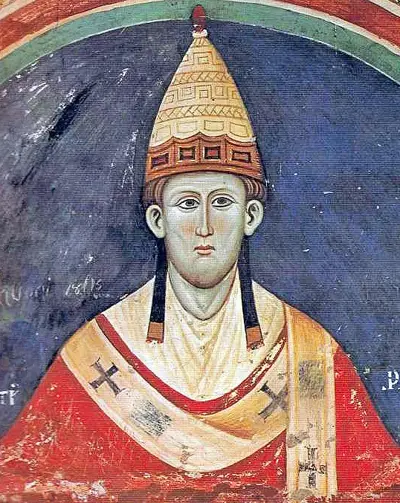
Pope Innocent III was the 176th Pope of the Catholic Church from 8 January 1198 to his death.
