Philip II of Spain Quotes
I would rather reign in a desert than over a country peopled with heretics.
The King, a religious fanatic, was a great supporter of the Inquisition whose excesses were even more horrible during his reign than others.
Philip II, 1527-1598, King of Spain, Naples and Sicily, Quoted in Mark Williams, The Story of Spain
Sourced by: Eigen's Political and Historical Quotations

The King, a religious exremist fanatic, was a great supporter of the Inquisition whose excesses were horrible during his reign.


While Aquinas brought much wisdom and good to the Church, this statement and others laid a foundation for murdering non-believers and organizing the Inquisition.

In this speech, and in {634756}, he argued against unification to a public that was mostly opposed. The leadership was interested because they were facing the Muslim Ottoman Turks who were getting more powerful each day. The Eastern Emperor, Constantine XI, more of a soldier and politician than a cleric, wanted the military strength of the Franks and other Western European Christian armies to help protect the Eastern Empire and Byzantium and were willing to reunite under the Pope to get it. Gennadios and his faction were not. They prevailed and the next year, the Muslims conquered Byzantium which had little help from the armies of the Western Roman Empire.


The mullahs had a great deal of power in Iraq and were among the most vocal opponents of democracy and freedom and instead argued for a Theocracy under Islamic law—Sharia which allowed almost no freedoms for the individual.
At the time Islam was quite conflicted about the role of innovation, science and reform. Innovators were to many theologians as dangerous to society as heretics and had to be refuted. Al-Ashari’s school of thought has prevailed in much of the Muslim world to this day.

Alfonso the Learned. He personally wrote a History of Spain up to the time.

This was the beginning of the inquisition.

Although James’ mother, Mary Queen of Scots had been a Catholic, James was a fervent Protestant. However, he found the separation of the State from authority over the church and the Presbyterian approach not to his liking. Also, the early tradition of the Presbyterian preachers scolding the monarch, especially his mother, was uncomfortable for James.

From what is now Turkey. Once the Christians had become established, critics or reformers, were hard to understand as the Christians were a few hundred years earlier.


Official List of groups which were prohibited from religiously criticizing the Catholic Church—the established church of Maryland. One interesting observation is that the Jesuits—a Catholic order were on this list. Catholic orders did not then subject their representatives to the authority of the local bishops and took direction only from the Pope. In the case of the Jesuits at the time, there were many who believed the Jesuits were beyond the de facto control of the Papacy and some Jesuits thought they should be—thus the two designations of Jesuits. This makes clear the fundamental intolerance that was common on many parts of Colonial America, that criticism of and heresy to the Established Church was not to be permitted. To the orthodox Catholics of Maryland, they were as concerned with the potential criticisms of Catholic Jesuits as they were with those of Puritans or Anabaptists. Compare Maryland, a Catholic colony with a huge antipathy towards Puritans, with Massachusetts, a Puritan Colony, and its strong antipathy and intolerance for Catholics. It is almost impossible to imagine a union of the American colonies without a 1st Amendment.

This edict gave great support to the Inquisitors of all Catholic countries. See {617572}

Bashir advocates adapting Sharia—Islamic Law—for all people in Indonesia—regardless of their religion or their preference for separation of church and state. This is diametrically opposite to an Islamic Syrian poet of 1000 years ago—see {624477}. Many Muslims have become more intolerant than some of their earlier scholars. Bashir also differs from most Indonesian Muslims who have historically not shared his bigotry and intolerance.
Toleration is a relative term. The Muslim Moors made Christians (and Jews) pay a special tax. At times they were forced to wear special clothing so that they could be readily identified. And they could not build churches larger or taller than the smallest mosque in the community. At times, their occupations were restricted but at other times Christians and Jews were appointed to the highest positions like Vizier. The Inquisition, in contrast, forced all Muslims (and Jews) to leave the country without any of their property or money or be tortured and killed—usually by burning at the stake unless of course that they converted to Christianity.

This famous quotation has been attributed to Voltaire, 1694-1778, and French Philosopher, Denis Diderot, 1713-1784. Most quotation collections erroneously attribute it to Diderot in the version “Men will never be free until the last king is strangled with the entrails of the last priest.” Both Voltaire and Diderot used the quotation as did many others opposed to monarchy and the then repressive church hierarchies. But the origin of the famous phrase was with Meslier. When the priest died, three handwritten manuscripts were found written and signed by him in which he attacked religion in general and the church and the Bible in particular. His Testament was read by Voltaire and Denis Diderot among others and he was very influential in their development as opponents of organized religion.


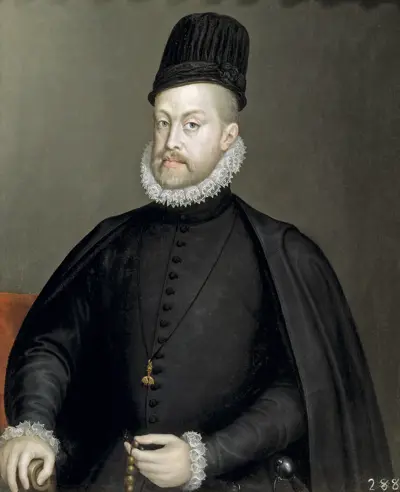
Philip II was King of Spain (1556–1598), King of Portugal (1580–1598, as Philip I, Portuguese: Filipe I), King of Naples and Sicily (both from 1554), and jure uxoris King of England and Ireland (during his marriage to Queen Mary I from 1554 to 1558). He was also Duke of Milan from 1540. From 1555 he was Lord of the Seventeen Provinces of the Netherlands.
