King James I Quotes
A Scottish Presbytery … agreeth as well with a monarch as God and the Devil … I give not a turd for your preaching.
Although James’ mother, Mary Queen of Scots had been a Catholic, James was a fervent Protestant. However, he found the separation of the State from authority over the church and the Presbyterian approach not to his liking. Also, the early tradition of the Presbyterian preachers scolding the monarch, especially his mother, was uncomfortable for James.
James I, 1566-1625, King of Great Britain & Scotland (James VI of Scotland), Statement to a delegation of Scottish Presbyterians, Hampton Court Conference, 1604
Sourced by: Eigen's Political and Historical Quotations


Some politicians then and later were not as religious as the leading clerics would prefer. The quotation shows that priests commonly married at that time even though the church had forbidden it.


This famous quotation has been attributed to Voltaire, 1694-1778, and French Philosopher, Denis Diderot, 1713-1784. Most quotation collections erroneously attribute it to Diderot in the version “Men will never be free until the last king is strangled with the entrails of the last priest.” Both Voltaire and Diderot used the quotation as did many others opposed to monarchy and the then repressive church hierarchies. But the origin of the famous phrase was with Meslier. When the priest died, three handwritten manuscripts were found written and signed by him in which he attacked religion in general and the church and the Bible in particular. His Testament was read by Voltaire and Denis Diderot among others and he was very influential in their development as opponents of organized religion.


As a result of Henry VIII establishing himself as the head of the Church in England and Ireland in place of the Pope, Henry’s heirs also became head of the Church. And that was the role that Queen Elisabeth had inherited in addition to the Crown. Many of those loyal to the Pope found most offensive the fact that a woman was making decisions for men and women on matters of faith. A Papal representative travelled with FitzGerald and probably helped him compose this document of which this is but 2 sentences. He may have drafted it completely. The Pope was a factor in many of the Irish rebellions against the English, and this caused great suspicion of all English Catholics whose loyalty to the Queen was in conflict with their loyalty to the Pope who was plotting for a Catholic takeover of England and Ireland.

The King, a religious fanatic, was a great supporter of the Inquisition whose excesses were even more horrible during his reign than others.


Alfonso the Learned. He personally wrote a History of Spain up to the time.

The letter was written at the behest of the Archbishop of Canterbury. The quotation appears to ratify the Pope’s unlimited power, but in actuality carves out an exception whereby the Pope’s authority might be challenged in the future. Specifically, it claims the Pope has not the authority to alter that which “by the word of God, has eternal validity.” Politically, this position put the pope in a box. By arguing against the proposition, the Pope would have to maintain that he should have the right to alter the word of God that had eternal validity which no pope wanted to state. By not challenging the doctrine, there was an opening by which the pope’s omnipotence could be challenged in the future.

This is a particularly interesting historical quotation because it succinctly gives a history of the various horrors of religious strife in British history—a history that was very well known to the American Founding Fathers and the general American Colonial population. This history was the major driver behind the public insistence for the Bill of Rights and the 1st Amendment which erected a wall of separation between church and state with government never favoring or abetting any particular religion.

While Aquinas brought much wisdom and good to the Church, this statement and others laid a foundation for murdering non-believers and organizing the Inquisition.

This statement in particular was extremely problematical. Sarbi is not just any old Mullah, but the Mufti of Jerusalem, on of the highest ranking Muslims in the World. This statement puts countries like Egypt and Jordan in a very difficult situation as the officials making treaties with the U. S. will be in effect excommunicated.

The King assumed the role of head of the Church of England.
This quotation is one of the most powerful indictments of religion in the political sphere. Historically, religions have supported the status quo in political society even. However, individual clerics have been in the forefront of many if not most of the movements toward freedom and democracy. For example, American religious institutions general supported slavery and legal discrimination thereafter, yet clerics were major abolutionists and major contributors to the Civil Rights Movement. Even today, American churches are the most racially segregated institutions left in America. See {620780} for his view on Christianity in particular.
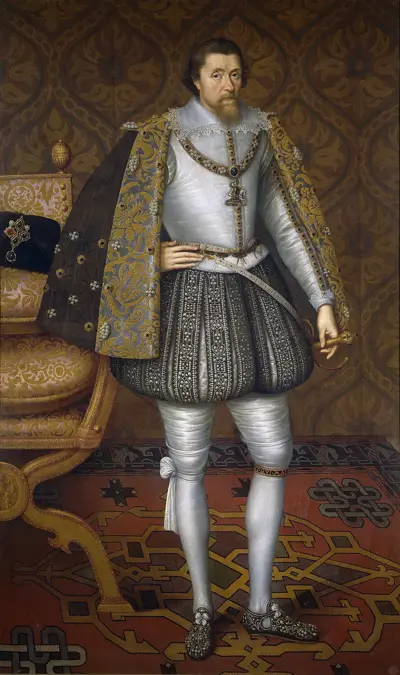
James VI and I was King of Scotland as James VI from 24 July 1567 and King of England and Ireland as James I from the union of the Scottish and English crowns on 24 March 1603 until his death in 1625. The kingdoms of Scotland and England were individual sovereign states, with their own parliaments, judiciaries, and laws, though both were ruled by James in personal union.
