Bede Quotes
Nor were the laity only guilty of these things, but even our Lord’s own flock, with its shepherds, casting off the easy yoke of Christ, gave themselves up to drunkenness, enmity, quarrels, strife, envy, and other such sins
Bede, 673-735, English Historian, Description of 5th Century Briton Clergy, Ecclesiastical History of England
Sourced by: Eigen's Political and Historical Quotations

He was the last Pope to hold temporal power.


Although James’ mother, Mary Queen of Scots had been a Catholic, James was a fervent Protestant. However, he found the separation of the State from authority over the church and the Presbyterian approach not to his liking. Also, the early tradition of the Presbyterian preachers scolding the monarch, especially his mother, was uncomfortable for James.


This was the at the time, a typical assessment of the English, Welsh and Scotts about the Irish who were perceived as a lower class of nation. Most interesting was the irreligious perception of a people who would become the most faithful and orthodox of Roman Catholics.


3rd Earl Russell of Kingston

In 17th century England the Puritans were major opponents of the Celebration of Christmas which at the time had been celebrated mostly by Roman Catholics.


Lotario de' Conti
Colton also ordered the Abbot to have no further mistresses. There was a basic concern about and prejudice against the Irish for their relatively promiscuous norms regarding sex. See {639438}.
The Protestant Clergy issued similar statements. This was one of the few areas of agreement.


Gregory the Great. “Emoluments” included the income from all lands and other church property, gifts and tithes, and income of any sort. This formula characterized the division of resources for the better part of Christian history. By today’s standard, the proportion for these Bishops (there were those who chose poverty) and his household seems astoundingly high—his income and sustenance was the equal of all the priests in the bishopric. It illustrates the affluence of the bishops who were major forces in their territories. One of the rationales for such an affluent bishop (the assets were not all personal but he had control of them) was that he should be at least the equal of any in the area including kings and nobles for he was to have as much influence as they. It is difficult today to look at modern bishops and realize how their role, power, relative wealth, and influence has changed. Bishops had their own armies, judiciary, accountants, attorneys and were a government unto themselves.
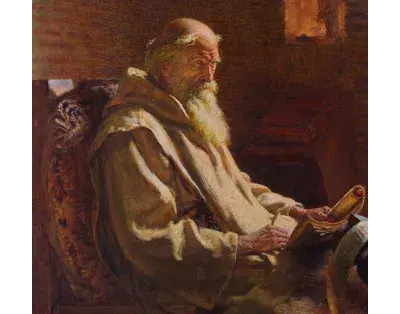
Bede, also known as Saint Bede, The Venerable Bede, and Bede the Venerable (Latin: Beda Venerabilis), was an English Benedictine monk at the monastery of St. Peter and its companion monastery of St. Paul in the Kingdom of Northumbria of the Angles (contemporarily Monkwearmouth–Jarrow Abbey in Tyne and Wear, England).
