Gregory I Quotes
It is the custom of the Apostolic see to prescribe these rules to bishops when they are ordained: that all emoluments which accrue, are to be divided into four portions ;—one for the bishop and his household, for hospitality and entertainment of guests; another for the clergy; a third for the poor; and the fourth for the repair of churches.
Gregory the Great. “Emoluments” included the income from all lands and other church property, gifts and tithes, and income of any sort. This formula characterized the division of resources for the better part of Christian history. By today’s standard, the proportion for these Bishops (there were those who chose poverty) and his household seems astoundingly high—his income and sustenance was the equal of all the priests in the bishopric. It illustrates the affluence of the bishops who were major forces in their territories. One of the rationales for such an affluent bishop (the assets were not all personal but he had control of them) was that he should be at least the equal of any in the area including kings and nobles for he was to have as much influence as they. It is difficult today to look at modern bishops and realize how their role, power, relative wealth, and influence has changed. Bishops had their own armies, judiciary, accountants, attorneys and were a government unto themselves.
Gregory I, ~540-604, Roman Catholic Pope, Letter to Augustine of Canterbury, ~600
Sourced by: Eigen's Political and Historical Quotations

In Ireland at the time the established church—the Protestant Anglican Church of Ireland—had the legal right to collect annual Tithes from the population in order to fund the activities of the Church. One difficulty however, was that the majority of the population were Roman Catholics. The poorest of them could not afford the tithe payments to any church. The Irish Protestant clergy lived in a particularly sumptuous style and were much more interested in politics and maintaining the Protestant ascendency than they were in ministering to the poor and had no interest in aiding the Catholic poor.
This was quite unusual at the time when Kings were more interested in buying the loyalty and support of the rich and powerful nobles.

In this particular injunction the Queen actually proscribes the amount of church revenues that MUST be distributed to the poor. See {617526} where actual prayers are proscribed by the government.

Clerics of the age were often combinations of fund raisers and tax collectors.

He argued that the clergy should cease to own lands and peasants and that bishops and the Pope should give up their temporal power. He was labeled a heretic for these views.
Cyprian was the leader of the Christian Church in Africa. His non-authoritarian style was a radical departure from then civil and religious organizational style. Jews had moved back and forth between Congregational and authoritarian religious organization before, Cyprian’s democratic approach was short lived as the Catholic Church structure evolved emulating, and contesting with, civil authoritarianism. Cyprian’s approach presaged the Christian Congregational development that became the basis of most early American Christian churches.


This was a fairly radical constraint on what had been a traditional priestly prerogative throughout the ages. However, the penalty for such a sin and infraction was rather modest—a warning for the first offence, followed by reducing the cleric’s income. There were more serious punishments proscribed for repeated offenses, but typical of most reform efforts a newly prohibited activity carries a very light penalty. For example $20 fines for providing alcohol to a minor was the initial penalty in some states. A then current comparison can be made since elsewhere in this council dueling between Christians was also prohibited. But the penalty for even the first offence was excommunication.
The council was not only fearful of Protestant preaching, but hereby granted a local monopoly within the Catholic Church to the local Bishop.

Many of the Church wanted Wycliff excommunicated, but the King and Parliament seemed to like his writing and sermons. So he was protected in his lifetime. He died at the age of 60 of a stroke. After his death the Church burned all his books that had been banned, and exhumed his body. That was burned at the stake and his ashes scattered in a river. Martin Luther did not try to reform the Church in a vacuum. There had been various critics of the Church before Luther and Wycliff was one. The last statement in this quotation was the one that really hit the then mostly corrupt clergy where it hurt.

The level of religious charity would be impressive for modern times. It is a marvelous insight into 14th Century Damascus.

William the Conqueror. This is one of the earliest government action separating some church functions from state functions.
Head of the Sikh Religion. He was the first Sikh Guru to utilize weapons,

This quotation illustrates how the power and mechanism of an established church operated to control ideas and maintain theological monopoly. In this case, no one could sell or rent any facility in the city to a cleric or church of any kind or persuasion without first having the approval of the Bishop who had theological control of that territory. Even Catholic scholars could not rent a room in the city unless their scholarship met with the Bishop’s approval. This was history with which the American Founding were very familiar, and wanted to avoid by adopting the 1st Amendment.


For many religions and ethical systems, it is better to have personal contact with the recipient of charity than to give money.
In Ireland at the time the established church—the Protestant Anglican Church of Ireland—had the legal right to collect annual Tithes from the population in order to fund the activities of the Church. One difficulty however, was that the majority of the population were Roman Catholics. The poorest of them could not afford the tithe payments to any church. Whereas in the past, the Protestant Church officials did not force the issue of tithe collection from the poor, in about 1830 they changed and seized the property of the poor (Protestants and Catholics) and auctioned it off to pay for the tithe. The Cardinal organized a campaign of non-violent civil disobedience to combat the Tithe. See {639227}.

King Henry VIII had left the Roman Catholic church and taken England and Ireland out also. He replaced the Pope as the head of the English and Irish churches. There was much opposition in Ireland and the priests were the most assertive opponents to the change and were still loyal to the Pope. Queen Elizabeth continued to have problems with the Priests. James I, Elizabeth’s successor, became fed up by the Roman Catholic Priests and therefor issued this Proclamation.
Colton also ordered the Abbot to have no further mistresses. There was a basic concern about and prejudice against the Irish for their relatively promiscuous norms regarding sex. See {639438}.


Gregory the Great. In the earlier years of the Roman Catholic Church it was more catholic in the sense that is looked to incorporate outside elements wherever they thought there might be benefit. The rigidity of which leaders of the Reformation would later complain had not yet set in.
Augustine had been sent by Pope Gregory to bring Christianity to England. He began by trying to preach to King Ethelbert and his court. The king’s response was the essence of what most modern democratic societies would formulate as a policy and is given in full. It is one of the great statements of religious toleration in the history of the world.
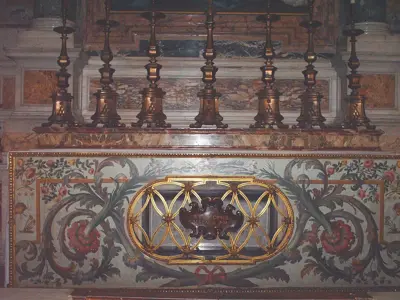
Pope Gregory I, commonly known as Saint Gregory the Great, was the bishop of Rome from 3 September 590 to his death. He is known for instigating the first recorded large-scale mission from Rome, the Gregorian Mission, to convert the then-pagan Anglo-Saxons in England to Christianity. Gregory is also well known for his writings, which were more prolific than those of any of his predecessors as pope. The epithet Saint Gregory the Dialogist has been attached to him in Eastern Christianity because of his Dialogues. English translations of Eastern texts sometimes list him as Gregory "Dialogos", or the Anglo-Latinate equivalent "Dialogus".
