ALCUIN
(Alcuin of York | Flaccus Albinus Alcuinus)
This quotation is almost always given as if it were Alcuin who advocated listening to the people, when actually his view was just the opposite. See William Tecumseh Sherman for a more modern expression of the same view. Also, Walter Reynolds {32317} for an opposite view, but using a similar phrase. Note that since he was referring to what "the people" say, the quote must have been in common usage in the 9th century. For the earliest known use of the statement in Western civilization, see Hesiod {603399}.
What Alcuin did not say was that Charlemagne had the largest and most powerful army.
Even then most students did not want to study mathematics.
There was a continuing power struggle between the more powerful kings of Europe and the Roman Catholic Pope. This struggle however was not one of church and state. Neither the kings nor the clergy viewed the two as separate domains. Instead they saw the two in much the same way as the ancient Jews and many contemporary Muslims view relationship—as an inseparable amalgam. However there was much debate over who could best protect and manage the amalgamated entity. In this case Alcuin was arguing that Charlemagne could ensure the well-being of the church better than the Pope. The power struggle went on for centuries between more or less able, powerful, and corrupt kings and popes.
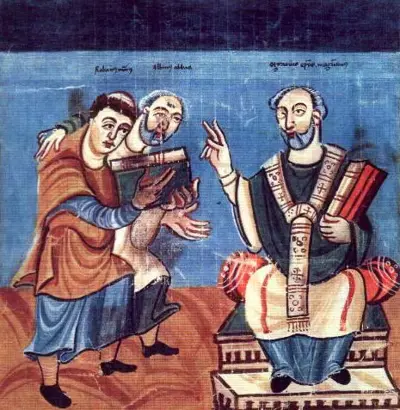
Alcuin of York – also called Ealhwine, Alhwin, or Alchoin – was an English scholar, clergyman, poet, and teacher from York, Northumbria. He was born around 735 and became the student of Archbishop Ecgbert at York. At the invitation of Charlemagne, he became a leading scholar and teacher at the Carolingian court, where he remained a figure in the 780s and 790s. "The most learned man anywhere to be found", according to Einhard's Life of Charlemagne (c. 817–833), he is considered among the most important intellectual architects of the Carolingian Renaissance. Among his pupils were many of the dominant intellectuals of the Carolingian era.
