Alcuin Quotes
Be ...a preacher of piety, not an exactor of tithes...
Clerics of the age were often combinations of fund raisers and tax collectors.
Alcuin [Flaccus] of York, ~735-804, English Scholar & Abbot, Advice to a Missionary
Sourced by: Eigen's Political and Historical Quotations


Philip II, by this statement, and his subsequent behavior, made a major step forward in France for the separation of church and state. Previously, French kings played a major part in the selection of the bishops and other high clerics of the realm. Phillip ceased that type of interference. He did however, close down a religious commune for misbehavior, but that was at the request of both the church and civil authorities. See {617074} . The religious authorities at the time were delighted with this form of separation of church and state, but they were adamant that their church should be able to influence the monarchy and laws of the realm. In contrast today, the Chinese government does not allow any religion to interfere with the operation of the government, but insists that the Dali Lama and the Bishops of the Catholic church can only be appointed with their approval. Separation of church and state is a two way phenomenon.


In 1980 Pope John Paul II issued a general order prohibiting priests from holding civil political positions. Many wondered whether Drinan, a marvelous and popular Congressman, would obey and leave Congress. He announced he was not going to seek election and his colleague immediately after his announcement asked him to share his thinking. This was his response.


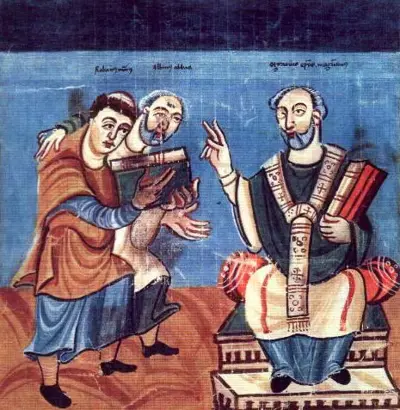
Alcuin of York – also called Ealhwine, Alhwin, or Alchoin – was an English scholar, clergyman, poet, and teacher from York, Northumbria. He was born around 735 and became the student of Archbishop Ecgbert at York. At the invitation of Charlemagne, he became a leading scholar and teacher at the Carolingian court, where he remained a figure in the 780s and 790s. "The most learned man anywhere to be found", according to Einhard's Life of Charlemagne (c. 817–833), he is considered among the most important intellectual architects of the Carolingian Renaissance. Among his pupils were many of the dominant intellectuals of the Carolingian era.
