John Calvin Quotes
About twenty-four years ago the defendant commenced to annoy the churches of Germany with his errors and heresies, He printed a wretched book, which has infected many people He has not ceased by all means in his power to scatter his poison, as much by his construction of biblical text, as by certain annotations which he has made upon Ptolemy [He has claimed] that little children are sinless, and moreover are incapable of redemption until they come of age; that they do not commit mortal sin up to the age of twenty.
Michael Servetus, 1511-1553, a Spanish theologian, was tried and burned at the stake in Switzerland. John Calvin drew up the charges and pronounced the sentence. However his ill health prevented him from personally officially reading the charges. De la Fontaine did it in his stead. Most people are familiar with the charges of questioning the doctrine of the Trinity. However, before those there were a series of more civilly oriented charges of which sever are given herein. Note the emphasis on his book. It was found do offensive that it was burned along with Servetus. See related quote.
John Calvin, 1509-1564, Lawyer and Protestant Minister, Founder of Calvinism, Nicholas de la Fontaine, *, Some of the Charges Prosecuted Against Servetus, August 14, 1553
Sourced by: Eigen's Political and Historical Quotations

Servetus’ book On the Motion of the Heart and Blood of Animals, was so threatening that of the 1000 copies that were printed only 3 survived the burning including ironically Calvin’s personal marked up copy.

The King, a religious exremist fanatic, was a great supporter of the Inquisition whose excesses were horrible during his reign.


While Aquinas brought much wisdom and good to the Church, this statement and others laid a foundation for murdering non-believers and organizing the Inquisition.

At the time Islam was quite conflicted about the role of innovation, science and reform. Innovators were to many theologians as dangerous to society as heretics and had to be refuted. Al-Ashari’s school of thought has prevailed in much of the Muslim world to this day.


The Church exercised the law enforcement and censorship authority in all Catholic countries. Note the offense of saying anything which is “offensive to pious ears”. The particular example that “offended” the pious was that a heretic should not be executed. These were the cultural values of the day.

This edict gave great support to the Inquisitors of all Catholic countries. See {617572}
This statement in particular was extremely problematical. Sarbi is not just any old Mullah, but the Mufti of Jerusalem, on of the highest ranking Muslims in the World. This statement puts countries like Egypt and Jordan in a very difficult situation as the officials making treaties with the U. S. will be in effect excommunicated.

Whoever teaches differently from what I have taught, … condemns God and must remain a child of hell.
Humility and doubt were not characteristics of Martin Luther.

Ingersoll was considered to be the greatest orator and political thinker of his day, but his overt atheistic views curtailed his elected political career.

Luther’s attitude toward the Catholic mass was the main reason the Protestant churches abolished the mass.


Samuel Langhorne Clemens, 1835-1910

The Christian Roman Empire was split in two—a Western (Latin) Empire led by the Roman Catholic Church in Rome, and the Eastern (Greek) Roman Empire led by the Orthodox Church headquartered in Constantinople (Byzantium). The two churches were not only in a theological conflict but violence broke out and the armies of the two religious empires attacked each other now and then. In 1439, leaders of the two versions of Christianity met in Florence, and they agreed to reunuion in which the Eastern Orthodox would again acknowledge the authority of the Pope. This was not a popular agreement with the majority of the Eastern Orthodox people and some of the clerical leadership. Constantine, realizing that he did not have pubic support at home for the end to the schism and the acceptance of the authority of the Pope, kept stalling on officially announcing and implementing the unity treaty. The Pope’s patience was wearing thin. Constantine did not adhere to ther treaty and the two churches have been apart ever since.


He was officially hanged for his offence of blasphemy. See {619712}. His execution, which raised considerable concern, was the last execution for blasphemy in Britain.
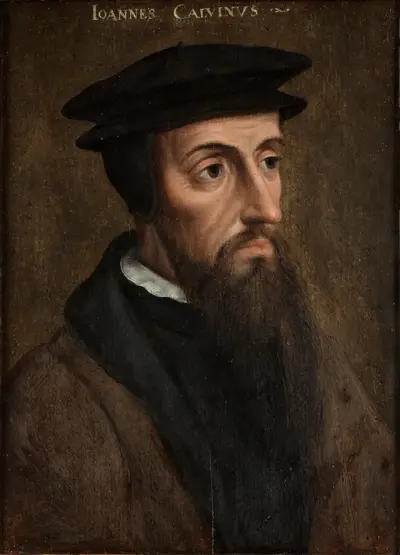
- Born: July 10, 1509
- Died: May 27, 1564
- Nationality: French
- Profession: Reformer, Minister, Author
John Calvin was a French theologian, pastor and reformer in Geneva during the Protestant Reformation. He was a principal figure in the development of the system of Christian theology later called Calvinism, aspects of which include the doctrines of predestination and of the absolute sovereignty of God in salvation of the human soul from death and eternal damnation, in which doctrines Calvin was influenced by and elaborated upon the Augustinian and other Christian traditions. Various Congregational, Reformed and Presbyterian churches, which look to Calvin as the chief expositor of their beliefs, have spread throughout the world.
