John Calvin Quotes
We condemn you, Michael Servetus, to be bound and taken to Champel and there attached to a stake and burned with your book to ashes.
Servetus’ book On the Motion of the Heart and Blood of Animals, was so threatening that of the 1000 copies that were printed only 3 survived the burning including ironically Calvin’s personal marked up copy.
John Calvin, 1509-1564, Lawyer and Protestant Minister, Founder of Calvinism, Sentence of Spanish “Heretic” Physician Michael Servetus, 1511-1553, 1553
Sourced by: Eigen's Political and Historical Quotations

Michael Servetus, 1511-1553, a Spanish theologian, was tried and burned at the stake in Switzerland. John Calvin drew up the charges and pronounced the sentence. However his ill health prevented him from personally officially reading the charges. De la Fontaine did it in his stead. Most people are familiar with the charges of questioning the doctrine of the Trinity. However, before those there were a series of more civilly oriented charges of which sever are given herein. Note the emphasis on his book. It was found do offensive that it was burned along with Servetus. See related quote.


Since Muslims try and convert others, one who changes religion and becomes a Muslim is exempt. The death penalty is reserved for Muslims who leave the religion.

This was a poem about the early persecution of Quakers.

Ingersoll was considered to be the greatest orator and political thinker of his day, but his overt atheistic views curtailed his elected political career.

While Aquinas brought much wisdom and good to the Church, this statement and others laid a foundation for murdering non-believers and organizing the Inquisition.


He was assassinated by his bodyguard the following week. See {620972}. This appears to be the first time that a politician who was threatened with harm chose social media—in this case a Tweet--to inform supporters of his situation. The “blasphemy” for which he was accused was to oppose the death penalty for saying or writing anything that was heresy or blasphemy as interpreted be fundamentalist Muslims,


While Christianity and other religious groups were the inventors of these particular devices of compulsion of conscience, in modern times, but almost all other groups have given up torture and execution as a means of compelling religious obedience, many Muslim nations, even in modern times use the machine gun or the headman’s sword or other barbaric means to punish heretics. At the beginning of the third millennium, Islamic theocracies such as Iran, commonly executed followers of the Bhai and other non-Islamic religions. Many historians feel that the Muslims learned from the Christians such barbarity, but maintained the practices long after the questions had abandoned them. In addition, Shiite and Sunni Muslims have been butchering each other for centuries in dominate Islam nations and trying to force their interpretation of Islam in each other. The practice still continues.

The King, a religious exremist fanatic, was a great supporter of the Inquisition whose excesses were horrible during his reign.


Samuel Langhorne Clemens, 1835-1910

Hamilton had studied with Martin Luther at Wittenberg and returned to Scotland where he converted many from the Catholic Church. He was offered a chance to recant and spare his life but he refused. He became the first Protestant Martyr in Scotland and his death brought many new converts.
He had whipped the crowd up into a feverish pitch until someone rushed the bound and tied blacksmith and stabbed him to death. He had only criticized Mathias for being too harsh and stern a leader.

In most countries those who identify with the economic views of Mises also tend to be strong supporters of orthodox religion—usually Christianity. American conservative Republicans are typical. However they rarely are aware of views and quotations of their intellectual guru that are evidenced by this quote. See {632408} for another quotation that distressed many European conservative devotees of Mises.


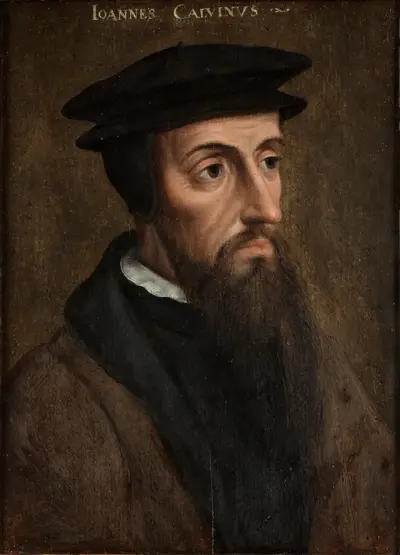
- Born: July 10, 1509
- Died: May 27, 1564
- Nationality: French
- Profession: Reformer, Minister, Author
John Calvin was a French theologian, pastor and reformer in Geneva during the Protestant Reformation. He was a principal figure in the development of the system of Christian theology later called Calvinism, aspects of which include the doctrines of predestination and of the absolute sovereignty of God in salvation of the human soul from death and eternal damnation, in which doctrines Calvin was influenced by and elaborated upon the Augustinian and other Christian traditions. Various Congregational, Reformed and Presbyterian churches, which look to Calvin as the chief expositor of their beliefs, have spread throughout the world.
