Dean Inge Quotes
The Church burned Bruno and imprisoned Galileo. The Church has lived by its monopolies and conquered by its intolerance.
William Ralph Inge, 1860-1954, British Anglican Prelate & Dean of St. Paul's, Time Magazine Interview, November 24, 1924
Sourced by: Eigen's Political and Historical Quotations

There had been terrible religious wars between Catholics and Protestants in English history. The Protestants finally won and the Anglican Church of England became the “official” state church, but as England became a Democracy the power of the prelates and the church receded. However, there were fears of Catholic politicians in England that they were “controlled by the Pope” and if Catholics were too heavily part of the political system, the Pope might control and dominate English policy. Inge, one of the highest ranking Anglican clerics, allayed this fear, not by denying that the Popes and the Vatican might be interested in gaining more influence in England, but by appealing to the independence of the average Englishman and diminishing the spectre of the Pope by referring to him as an “Italian Priest.” As Inge and other high ranking Anglicans were in the English power system only English Priests. Inge at the time saw the Roman Catholic Church as a narrow, intolerant, monolithic anti modern institution. See {615671}. He argued that fear was inappropriate not because of the nature pf the Roman Church, but because of the characteristics of Englishmen, American Protestants had similar fears and Al Smith was defeated as President mainly because he was Catholic. For all but the worst religious bigots, this fear ended in America with the election of JFK.


The Holy Roman Emperor and the Pope were at odds. The Pope had issued an edict staking out the powers of the Pope. King Henry called a conclave of clerics and deposed Pope Leo VII. The Pope Excommunicated Henry and deposed him as king and emperor. Civil war ensued, and finally they reached a compromise and accommodation with each other." Saint Hildebrand

King Henry VIII had left the Roman Catholic church and taken England and Ireland out also. He replaced the Pope as the head of the English and Irish churches. There was much opposition in Ireland and the priests were the most assertive opponents to the change and were still loyal to the Pope. Queen Elizabeth continued to have problems with the Priests. James I, Elizabeth’s successor, became fed up by the Roman Catholic Priests and therefor issued this Proclamation.


The King, a religious exremist fanatic, was a great supporter of the Inquisition whose excesses were horrible during his reign.


Ingersoll was considered to be the greatest orator and political thinker of his day, but his overt atheistic views curtailed his elected political career.


Two were executed and the others sent to the Gulags. This is often quoted to show how hostile the Soviet Union was to all religions.

Before the Protestant Reformation of Martin Luther, there had been a schism of the Catholic Church into the Western Roman Empire—the Latins, headquartered in Rome; and the Orthodox Church—the Greeks, headquartered in Constantinople (Byzantium). One of the main issues of the schism was the Papacy itself. As this quotation shows, Luther was by no means the first to attack the Papacy. Saint Mark’s quotation here was more than 50 years before Luther was born.


This notice of Excommunication was promulgated to the Catholic clergy in Ireland in May of 1538. It required all Roman Catholic leaders to size the property of Protestants or Catholics who sympathized with them. Those who did were then regarded as traitors by the Protestant King. The anti-Protestant feeling culminated with the massacre of about 100 Protestants who were drowned in Bann a few years later.

Samuel Langhorne Clemens, 1835-1910
The Church exercised the law enforcement and censorship authority in all Catholic countries. Note the offense of saying anything which is “offensive to pious ears”. The particular example that “offended” the pious was that a heretic should not be executed. These were the cultural values of the day.
While the Visigoths had some very advanced legal principles, this law, quoted in its entirety is typical of the nations that were part of the Catholic world. The church and its doctrines were immune from any possible criticism, explicit or implicit. This is the most formalized and sophisticated compendium of laws of the so-called “barbaric peoples” of Europe. The compilation was in many ways a documentation of the traditional laws of the Visigoths that had evolved over hundreds of years.
Samuel Langhorne Clemens, 1835-1910

The Roman Catholic Church hierarchy had just cracked down on some nuns and their orders who were discussing and debating classic church positions, like male only priesthood, birth control, women’s roles in the society and in the search. There were many strongly worded admonishments from the Vatican. Down found it odd that the Church Fathers should be so distressed by activist nuns when their reaction to Priest sexual predation of young boys was by comparison, so mild.

The letter was written at the behest of the Archbishop of Canterbury. The quotation appears to ratify the Pope’s unlimited power, but in actuality carves out an exception whereby the Pope’s authority might be challenged in the future. Specifically, it claims the Pope has not the authority to alter that which “by the word of God, has eternal validity.” Politically, this position put the pope in a box. By arguing against the proposition, the Pope would have to maintain that he should have the right to alter the word of God that had eternal validity which no pope wanted to state. By not challenging the doctrine, there was an opening by which the pope’s omnipotence could be challenged in the future.

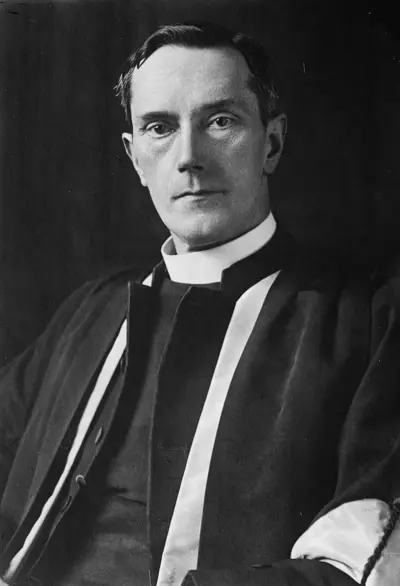
- Born: June 6, 1860
- Died: February 26, 1954
- Nationality: English
- Profession: Author
William Ralph Inge KCVO FBA (/ˈɪŋ/; was an English author, Anglican priest, professor of divinity at Cambridge, and Dean of St Paul's Cathedral, which provided the appellation by which he was widely known, Dean Inge. He was nominated for the Nobel Prize in Literature three times.
