Jacques De Molay Quotes
Not one of us has betrayed his God or his country. I do confess my guilt, which consists in having, to my shame and dishonor, suffered myself, through the pain of torture and the fear of death, to give utterance to falsehoods imputing scandalous sins and iniquities to an illustrious Order, which hath nobly served the cause of Christianity. I disdain to seek a wretched and disgraceful existence by engrafting another lie upon the original falsehood.
The Inquisition had tortured De Molay and his fellow Templars forcing them to confess to blasphemy, homosexuality and other capital crimes. Finally De Molay was sentenced to be burned at the stake. At the last moment he confessed to having lied under torture.
Jacques De Molay, 1243?-1314, French Grand Master of the Knights Templar, Last Words Before His Execution, 1314
Sourced by: Eigen's Political and Historical Quotations


This particular quotation was very damaging to Christians of the era. Voltaire was almost universally regarded as the greatest mind of Europe at the time. He was consulted by powerful monarchs and others throughout Europe. He influenced major figures of the day like Catherine the Great. Voltaire did believe in God. See {621200}.

The King, a religious exremist fanatic, was a great supporter of the Inquisition whose excesses were horrible during his reign.


Both Puritans and Quakers were persecuted and physically abused in England by the Anglican Church. The Puritans as soon as they became dominant in part of the American colonies began persecuting Quakers. The Quakers who were the majority in the Pennsylvania colony, however were tolerant of other religions. This history was another of the many reasons the Founding Fathers wanted no established church. A “scorpion” was a type of whip that was particularly painful.

In August of 1572 Catholics in Paris led by the Marshall and his soldiers attacked the homes of all known Huguenots, murdering the inhabitants. Tavannes rode through the streets of Paris on his horse shouting the first quotation to his troops who would murder the helpless Protestants. The frenzy spread to the countryside. When it was over 50,000 innocent, unsuspecting Protestants had been murdered. When asked how he, a military marshal felt about such a one sided action against unarmed civilians he responded with the second quotation. The event came to be known as the Massacre of Saint Bartholomew as it commenced on that Saint’s day.

Toynbee was very active in attempting to reform the Church of England.
Husayn Ali Nuri. The Persians executed Bahai as they considered these new religionists as Muslim heretics and Sharia—Islamic law—specified the death penalty for all the Muslims who convert or try and change the religion. After the Iranian revolution with the downfall of the Shah, the practice of executing Bahai in Iran was continued.

Louisiana was then a possession of France


Ingersoll was considered to be the greatest orator and political thinker of his day, but his overt atheistic views curtailed his elected political career.
Toleration is a relative term. The Muslim Moors made Christians (and Jews) pay a special tax. At times they were forced to wear special clothing so that they could be readily identified. And they could not build churches larger or taller than the smallest mosque in the community. At times, their occupations were restricted but at other times Christians and Jews were appointed to the highest positions like Vizier. The Inquisition, in contrast, forced all Muslims (and Jews) to leave the country without any of their property or money or be tortured and killed—usually by burning at the stake unless of course that they converted to Christianity.


He was the first American that who was assassinated by the Central Intelligence Agency by means of a drone attack. He was a major recruiter for Al Qaeda and he preached to 3 of the 9-11 terrorists.


Samuel Langhorne Clemens, 1835-1910


This quotation—presented in its entirety because it is so unbelievable—illustrates one of the uglier and nasty aspects of Colonial America. Most of us associate early American colonists with persecuted minorities escaping the intolerance of Europe, but so much of the concept of tolerance then concentrated on the rights of a religious community but provided little if any obligation to then be tolerant of OTHER minorities in their colonies and communities. In this case, Massachusetts Christians did not perceive Quakers as either Christians or another sect to be tolerated. They not only wanted the Quakers stopped from coming to other parts of America, but actually attempted to interdict the Quaker immigrant ship, capture the Quakers, and sell them into slavery in the Caribbean. What makes the incident even more offensive is that the ethics of this was never questioned and was even justified as Christian acts and even duty. The Welcome evaded the Porpoise The founding fathers knew about these incidents and the religious discrimination that was rampant in many Colonial communities as bad as England and Europe. Hence, the separation of Church and State concepts were not just protections against the way of the old world, but dealt with a clear and present danger that Colonial history had demonstrated.
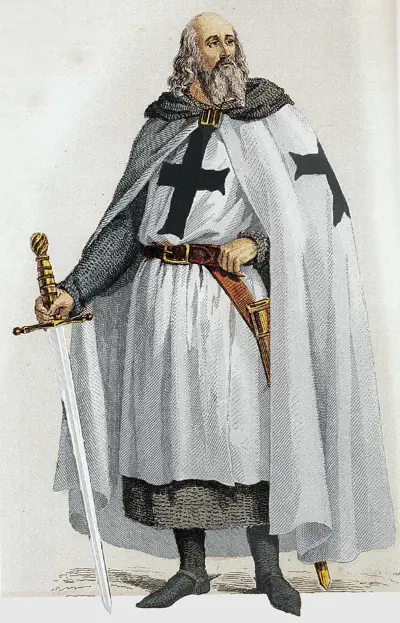
Jacques de Molay, also spelled "Molai", was the 23rd and last grand master of the Knights Templar, leading the order from 20 April 1292 until it was dissolved by order of Pope Clement V in 1312. Though little is known of his actual life and deeds except for his last years as Grand Master, he is one of the best known Templars.
