Theodore Roosevelt Quotes
The large corporations, commonly called trusts, though organized in one State, always do business in many States, often doing very little business in the State where they are incorporated. There is utter lack of uniformity in the State laws about them; and as no State has any exclusive interest in or power over their acts, it has in practice proved impossible to get adequate regulation through State action. Therefore, in the interest of the whole people, the Nation should, without interfering with the power of the States in the matter itself, also assume power of supervision and regulation over all corporations doing an interstate business.
Federal regulation of corporations involved in Interstate Commerce was then a “radical new notion”.
Theodore Roosevelt, 1858-1919, 26th President of the United States (Republican, NY) First Annual Message to Congress, December 3, 1901
Sourced by: Eigen's Political and Historical Quotations

TR came from a wealthy, upper class family, and because of his position favoring regulation of corporations he was called a traitor to his class by many.

During The Depression although business in general was doing very poorly, there were a few which had grown immensely powerful and abused the power as there was little or no regulation at the time.

Actually, both political parties had a range of opinion on the issue of control of the trusts, monopolies and large corporations. Roosevelt and his liberal wing of the Republic opinion were for regulating corporations and strengthening and enforcing the anti-trust laws. However, many of his party refused to admit that there were any abuses and/or if there were, the effect of Federal regulation and anti-trust enforcement would be worse that then problems caused by the trusts. At the same time, the Democrats had Bryan’s wing that wanted to break up the trusts and large corporations, and that is why Roosevelt had so much public support—enough to pass the legislation and make the President’s initiatives very popular. Roosevelt a shrewd campaigner attacked the Democrats knowing full well that many agreed with him, and ignored the conservative wing of his own party who were the ones who actively opposed his corporate reform effort.


The Chief Justice refused to accept the previously established legal precedents of other states which would limit considerably the right of the state to regulate corporations. As a result Wisconsin became one of America’s pioneers in regulating corporations which over 25 years later, Theodore Roosevelt was to do for the nation as a whole. The phrase “empire within an empire,” the translation of the Latin that Ryan used, has often been quoted to describe the power corporations had at that time.

The issue was could a person from another state come into New Jersey and dredge oysters with the same rights and privileges as a citizen of New Jersey? Washington said, no.

The term “great corporations” had been in common use to indicate large corporations with no implications of quality as “great” would imply today. Search for “great corporations” to see the common usage.


The President and his new appointee were half joking but many of the large corporations were attacking the new department and its head frequently. The extreme conservatives used the technique of personally discrediting the head of the agency to discredit the agency and its activities. The President himself was so popular that they did not dare attack him.


She was then the European Commissioner for Competition.

Boeing had the foresight to invest in the concept of Air Mail by bidding low at the beginning, becoming the best in the nation, and then raising prices when no one else can compete—a technique called “buying in”. However, he was so successful that he soon had a monopoly on all the airmail in the country. Each new airmail contract would require more and more capability and Boeing used the existing contracts to finance the R&D and training of manpower to present a better and better service. Soon, no other company could compete at any price. Boeing indeed had a monopoly but each step of the building of it he did at the request of the government or was the low bidder and saved the taxpayer money. The airmail contracts were canceled and air service was nationalized. William Boeing was so disgusted by the way he was treated in the Congressional Hearings, that he sold his interest in the Boeing Company and would have nothing to do with making planes or providing services to the government thereafter.

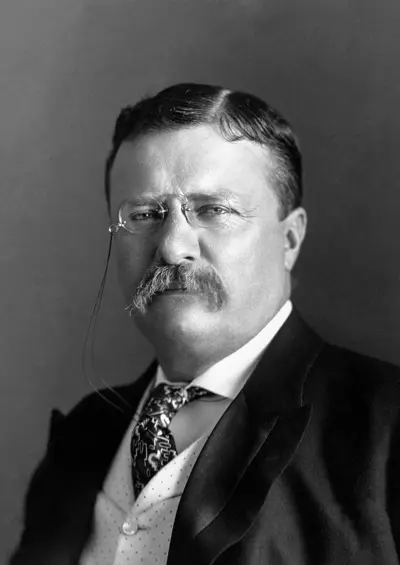
Theodore Roosevelt Jr., often referred to as Teddy or his initials T. R., was an American statesman, conservationist, naturalist, historian, and writer, who served as the 26th president of the United States from 1901 to 1909. He previously served as 33rd governor of New York from 1899 to 1900 and the 25th vice president of the United States from March to September 1901. Roosevelt emerged as a leader of the Republican Party and became a driving force for anti-trust and Progressive policies.
