Alfonso de Albuquerque Quotes
Tell the King of Siam that I am sure that he will rejoice with the destruction of the King of Malacca, with whom he has always been at war. Tell him that the King of Portugal will be pleased that the Siamese ships and people will trade again with Malacca and that this was the main reason for which I took the city. And tell the King of Siam that if he needs the support of our fleet our men to preserve his nation, I, as captain general of the King of Portugal, will serve him in everything he will command.
this quotation is one of the first references to Siam. It also illustrates the drive for trade. Malacca was a trading center but the King who was constantly in war with Siam did not want to allow the Siamese ships to bring their goods into his port to trade with the Europeans. A Portuguese had an interesting and novel concept of free trade. That and they should be free to trade with anyone in Asia, anywhere, so long as other European nations were not. Siam however was a much larger kingdom and Malacca and had much more skilled artisans and a greater variety of products. Therefore, Portugal sided with what Alfonso de Albuquerque decided would be its best supplier in the area.
Alfonso de Albuquerque, 1453-1515, Portuguese Naval General, Developer of the Portuguese Colonial Empire in India & SouthEast Asia, Instructions to his ambassador to the King of Siam (Thailand), January 1512 the
Sourced by: Eigen's Political and Historical Quotations


Hong Kong was not always a successful city or colony. In 1844 the British were thinking of swapping it for a better colony. However, in a rare combination of synergistic development of a colony, the great strengths of the Chinese and that of the English combined to make Hong Kong one of the best and well developed cities in the world. Few imperial colonies turned out as well.


He chronicled the early Portuguese entry into South-East Asia in the sixteenth century. Siam became Thailand.


Jefferson had been very much pro French and anti British, but the rise of Napoleon and French presence on the American continent shifted his views, culminating in the Louisiana Purchase. See {605059} for Jefferson’s view on the military significance of New Orleans.


He had introduced a bill to provision a military garrison at the mouth of the Columbia River on the West Coast and protect and develop trade with China and India. President Monroe was for it and he persuaded the House to vote for it, but the bill to encourage foreign free trade with the Orient died in the Senate. Floyd was another American ahead of his time. . Floyd was very modern in his economic views, so much so that he, even as a Southern politician, opposed slavery on the grounds that it was economically inefficient and the South would never develop industrially if it had no incentive, as existed in the North and England, to reduce the amount of labor required for economic opportunity. He was right on that point as well.

At the beginning of the dispute between America and England, the issue was the raising of internal American taxes by Parliament without any American representation in Parliament. The issue escalated and when the British began using force, independence then became the American objective.

Frederick the Great. He and many other Europeans thought that England had been so preoccupied with the American rebellion that she was ignoring Europe and other traditional foreign policy interests of theirs.

Some of the Patriots of Early America realized that the oppressions of British rule were coming from Parliament and initially took the position that only the King could make laws for the colonies and not Parliament. Therefore, they were as Englishmen challenging illegal English laws. Most American hostility was directed at Parliament and not the King. However, once there was any physical resistance, King George came down with such a heavy hand that American hatred transferred to him. For related quotes on the King/Parliament issue, see {639145}, {639143}, {639142}, {639141}, {639140}, & {639137}

A few months later, that is exactly what Germany did. She was hoping that England would not enter the war despite her treaty obligations, but she was willing to risk the possibility. The Czar had a strong espionage and intelligence service active in Germany, but, like so many other intelligence failures, the intelligence operatives and analysts had military and economic facts but had little understanding of the German culture which propelled Germany to what to most other cultures was “irrational policy making.” People and nations often engage in irrational activities, even against their own self-interest.


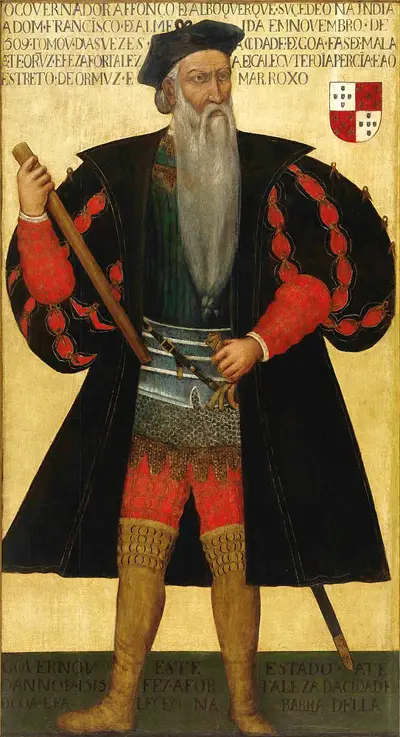
Afonso de Albuquerque, Duke of Goa (also spelled Aphonso or Alfonso) was a Portuguese general, admiral, and statesman. He served as Governor of Portuguese India from 1509 to 1515, during which he expanded Portuguese influence across the Indian Ocean and built a reputation as a fierce and skilled military commander.
