Nicholas II Quotes
Unless Germany has gone out of her mind, she will never attack Russia, England and France combined.
A few months later, that is exactly what Germany did. She was hoping that England would not enter the war despite her treaty obligations, but she was willing to risk the possibility. The Czar had a strong espionage and intelligence service active in Germany, but, like so many other intelligence failures, the intelligence operatives and analysts had military and economic facts but had little understanding of the German culture which propelled Germany to what to most other cultures was “irrational policy making.” People and nations often engage in irrational activities, even against their own self-interest.
Nicholas II, 1868-1918, Last Czar of Russia, Statement to some French guests, 1914
Sourced by: Eigen's Political and Historical Quotations


This was very much a minority opinion at the time, and has much historical significance as he was the father of the British Prime Minister, Neville Chamberlain, 1869-1940, whose appeasement of Germany led to Word War II. . See {585941}.


See the American ambassador’s assessment after the war began {41089}

But that is exactly what they did and the First World War was on. Europeans and Americans have often underestimated the political force of the common membership in the Orthodox Church.

The then Attorney General had established a back channel to the Russian agent. There was genuine fear by the Russians and some in America that there were still many Nazis and German nationalists who would try and influence, if not take over, German politics to produce another aggressive German fascist state. The Russians had lost 22 million citizens to the Germans in the war and had faced a defeated Germany where virtually every German over the age of 30 had been cheering for and supporting Hitler a decade ago. Neither the Russians nor we and the other allies had not yet seen the remarkable turn-around that the German nation would make and the intense anti-fascist, non-military ethos that would be brought by the younger German generations. The direction of Germany was then very unpredictable.


Leval was an appeaser and a collaborator with the Nazi’s. He led the government in name but the Germans really controlled the country. His actions killed tens of thousands of French men and women by turning them over to the Germans. After the Germans were defeated in WWII, Leval was shot as a traitor by the Free French forces.

The Times regretted that the Germans did not speak to the Austrians more vigorously when they were threatening to attack Serbia who harbored anti-Austro-Hungarian terrorists (see {642085}). What the Times editors did not realize was that the Germans had already made their war plans (see {642092}) and the Serbian issue was just the justification they needed to implement them. So there was no real reason for the Germans to discourage the Austro-Hungarian Empire from its mission to punish Serbia.

This is the kind of threat that was used by Germany before the First World War. It worked with Turkey, but King Albert realized that being an “ally” of Germany meant losing independence anyway. Belgium would not join Germany, so the Germans invaded Belgium in 1914. Belgians fought with the allies and at the end of WWI, they were able to rebuild their independent state and thrive until they were again invaded by Germany in WWII. Turkey, in contrast, lost their entire empire, as a result of their fighting as German allies in WWI.
This was the classic German method of invading a neutral country. First they claim that they have good information that their enemy, in this case France, is going to March through Belgium to attack Germany. Then they state that the Belgians are too weak to prevent this breach of their neutrality. Therefore, Germany as an act of “self defense” must send troops into Belgium to repel the French. The Belgians of course objected and stated that they would maintain their neutrality (see {613959} ) but the Germans then invaded the next day and could not understand why the world considered it aggression.

stating that war was obsolete See {640087} for the quotation of exactly what Angell wrote.


De Gaulle tended to see world affairs in terms of extreme, simplistic, and dramatic alternatives when reality is much more complex the truth was turned out to be for England a much more favorable outcome without either of these extremes.

Vladimir Lenin

See {636935}for the policy decision that triggered this order.
They were both children of Queen Victoria of England.

England had made diplomatic inroads in Holland and was with most Dutch more popular than France. There was also a lot of trade between Holland and England. Napoleon wanted to break the English-Dutch relationships.

Germany had just attacked Russia with whom it had a treaty. For a while, Hitler paid little attention to Italy and just gave their “ally” orders and instructions. Italian public opinion was concerned about the same question. See {627973} .
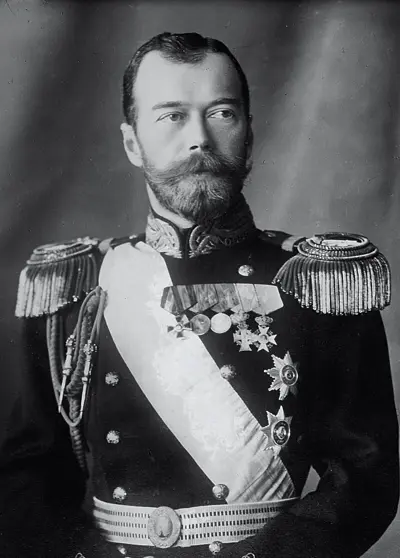
Nicholas II or Nikolai II Alexandrovich Romanov, known in the Russian Orthodox Church as Saint Nicholas the Passion-Bearer, was the last Emperor of All Russia, ruling from 1 November 1894 until his abdication on 15 March 1917. During his reign, Russia embarked on a series of reforms including the introduction of civil liberties, literacy programs, state representation, and initiatives to modernize the empire's infrastructure. Ultimately, this progress was undermined by Nicholas's commitment to autocratic rule, as well as defeats sustained by the Russian military in the Russo-Japanese war and World War I. By March 1917, public support for Nicholas had collapsed and he was forced to abdicate the throne, thereby ending the Romanov dynasty's 300-year rule of Russia.
