Noam Chomsky Quotes
We could not bring democracy and freedom to Vietnam at a cost acceptable to ourselves. The idea that that was what we were trying to do, is again, a tautology, it's true by definition because we were doing, and the state is noble by definition. That's called "extreme liberalism".
Chomsky, Noam. Understanding Power: The Indispensable Chomsky. Edited by Peter R. Mitchell and John Schoeffel, The New Press, 2002.


During the Cold War and afterwards many Americans attributed the problems we were having with the Soviet Union emenated from the fact that they were Communists, and our focus was anti-communism. Kennen, however argued that it was not Communism that was the cause of the Aggression of the Soviet Union. It was an extension of the Russian Culture. After the Soviet Union collapsed, and Communism was rejected by the Russians, we still had a great deal of Russian aggression and Foreign Policy problems with Russia. Kennan was right. It was the Russian culture, history, values and traditions that were the primary cause of most of the problems with Russia.

When Nixon was running for President in the 1968 Presidential campaign, he learned from Henry Kissinger that the Johnson administration had made an agreement with the Russians and North Vietnamese that America would stop the bombing of North Vietnam if there would be Peace Talks to end the Vietnam War. Nixon feard that although the polls showed him ahead of Vice President Humphrey, the announcement of ongoing peace talks would bring many of the anti-war Democrats who were not supporting Humphrey because of the Vietnam War out to vote for Humphrey to support the Peace Talks. Nixon decided to sabatouge the Peace Talks by persuading Vietnamese President Nguyen Van Thieu not to come to the peace table so there coulod be no talks. He accomplished this by having Anna Chennault, an extreme right-wing fund raiser who was the widow of General Chennault of Flying Tiger fame and who had connections with all the right wing politicans in Asia, get word to President Thieu that President Johnson would sell him out in the peace upcomming peace talks, and that if he would boycott the peace talks till after the American Presidential election, Nixon as the New Presidnt would be sure that Thieu would remain in control of South Vietnam or there would be no peace and America would continue the war until the North Vienamese would agree to a peace that kept Thieu in power. Earlier, Nixon had appointed Anna Chennault as the Offical Spokesperson of the Campaign on Asia. What Nixon did was a felony--private citizens are not alowed to intere with government negotiatons or descussions with foreign governments, under the Logan Act Many think that the action was legally Treason. Hoever, Nguyen VanThieu did boycott the peace talks despite all the entreaties of President Johnson and his administration. There were no peace talks and the public never even knew that there had been this attempt. The anti-Vietnam War voters mostly did not vote and Nixon won a close race. Shortly after the election, before Nixon could be sworn in, via the FBI Johnson learned of Chennault's activities but thee was no evidence to tie Nixon to the South Vietnam refusal to come to the peace table. It neever became a public issue although several leading politicians had learned what had really occured--see Quotation 664238. However, 0ver 40 years later, when Nixon's Chief of Staff's notes were finally made public, the smoking gun was dislosed and Farrell wrote this in his 2017 Biography of Richard Nixon. See Related Quotes for quotations from H. R. Haldman's hadnwritten notes of his phone call with Nixon, and other evidence that had also been uncovered.


A few months later, that is exactly what Germany did. She was hoping that England would not enter the war despite her treaty obligations, but she was willing to risk the possibility. The Czar had a strong espionage and intelligence service active in Germany, but, like so many other intelligence failures, the intelligence operatives and analysts had military and economic facts but had little understanding of the German culture which propelled Germany to what to most other cultures was “irrational policy making.” People and nations often engage in irrational activities, even against their own self-interest.

Most socialists in American and elsewhere initially supported the United States policy of intervention in the Vietnamese civil war. While they disapproved of much of the general economic policy, the Russian, Chinese and other Communist trampling on human rights seemed like a worse alternative.
South Vietnamese President Diem was thoroughly corrupt, and had little if any more respect for democracy and human rights than the North Vietnamese leadership did. Worse we scorned the intellectuals in his own country.
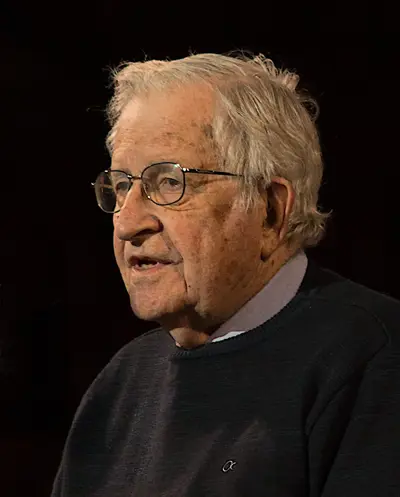
Avram Noam Chomsky is an American linguist, philosopher, cognitive scientist, historian, social critic, and political activist. Sometimes called "the father of modern linguistics", Chomsky is also a major figure in analytic philosophy and one of the founders of the field of cognitive science. He is Laureate Professor of Linguistics at the University of Arizona and Institute Professor Emeritus at the Massachusetts Institute of Technology (MIT), and is the author of more than 150 books on topics such as linguistics, war, politics, and mass media. Ideologically, he aligns with anarcho-syndicalism and libertarian socialism.
