Lyndon B. Johnson Quotes
Runty little bastard…just about the most dangerous person around [with a] powerful constituency.
Reference to George Wallace
Lyndon Baines Johnson, 1908-1973, 36th President of the United States (Democrat, TX), Quoted in Califano, Inside a Public and Private Life, 2004
Sourced by: Eigen's Political and Historical Quotations


This quotation is important for two reasons. First, this is one of the most negative attacks on an opponent in a Presidential election in all of American History—to call the opponent ‘dangerous’ to the nation. Second, it is a classic example of two close political friends and allies, after a falling out. Roosevelt had in effect made Taft President in 1908, but Roosevelt was extremely disappointed as Taft was controllable by the Republican Party bosses, who hated Roosevelt. TR then challenged the then sitting President for the Republican Presidential nomination. At that time there were 12 states that had primary elections and Roosevelt won 9 of them. La Follette won 2 and Taft only 1. The majority of the states did not then have primaries allowing the party bosses to make the decision of which candidate to support. Party leaders generally did not like Roosevelt who was a major reformer, so they voted for Taft at the convention pushing him over the top when he clearly was the less popular of all 3 candidates. Roosevelt, outraged by the party bosses overriding the will of the people, then walked out of the convention and organized his own convention and TR ran as the Progressive Party (Bull Moose Party). In the general election Roosevelt got more votes than Taft, but the two of them had split the majority Republican vote and the Democrat, Woodrow Wilson was the winner.


Baldwin when Prime Minister would not arm England to stop Germany and after he left office, supported his successor, Neville Chamberlain, in his peace efforts which turned out to be appeasement, See {626936}.

While Jones and Falwell were both fundamentalist, conservative Christians, Jones was very concerned that the Falwell propensity for being active in partisan politics would undermine Christian duty and faith as political compromises are always made and alliances require not attacking or criticizing political allies. Jones wanted Christians to be comfortable attacking the Republicans when they were morally deficient just as well as Democrats. He thought that Falwell’s approach was tempting for Christians but would undermine and destroy the integrity of Christians in America. Hence Falwell was dangerous.

The feeling was mutual. These two men hated each other as much as any two individuals in politics.


Clinton was a devout Methodist and sometimes wore a cross, though this was not frequent.


Metternich, the Chancellor of Austria under the Emperor was a very gifted and imposing diplomat. However he had little vision of the inevitable progress towards democracy and the liberalization of and limitation of the power of monarchs. His advice was on how to be better autocratic monarchs, not on how to reform and he saw no need for absolute monarchy to reform. He advocated press censorship and saw the press as a major enemy. See {630724}. The result was most of the monarchs who took his advice ended up being forced from power or required to cede much of their powers and “rights”. The English monarchs, after their disastrous civil war and its aftermath, in contrast, often led the reform to a constitutional monarchy where the powers and rights of the monarch was defined and limited by a Constitution. Victoria was one of the greatest of the English reforming monarchs, and saw Metternich’s conservatism as responsible for most of the disasters that befell the crowned heads of Europe while she had no such problems. See {607340} for Metternich’s negative view of Constitution.


Lord Dunsmore was John Murray, 1732-1809, the Royal Colonial Governor of Virginia who was one of the least competent of the British officials in Colonial America.


Kellis had blown the whistle on the Central Intelligence Agency as well as castigated Director Allan Dulles. The President acted and appointed General Jimmy Doolittle to conduct an investigation which confirmed the Kellis letter about the Central Intelligence Agency. The President ordered reforms but left Dulles in place as director. While Kellis was offended by Dulles’s immoral, un-Christian behaviors, some thought that we had to have people like that. See {634614} for a view that Eisenhower considered in keeping Dulles in place.


Jessie Helms was thought to be a by many a racist, misogynist, chicken hawk Senator from South Carolina.


Sunday put on a very dramatic show, often breaking furniture. Many intellectuals at the time thought him, as opposed to many other Christian Evangelists, a self-serving fraud. Defenders claimed that they targeted him because he was so effective.

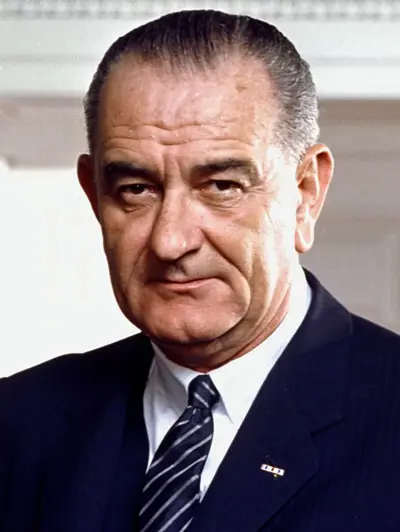
Lyndon Baines Johnson, often referred to by his initials LBJ, was the 36th president of the United States, in office from 1963 to 1969. He served as the 37th vice president from 1961 to 1963 and assumed the presidency following the assassination of President John F. Kennedy. A Democrat from Texas, Johnson was also a United States representative and later majority leader in the United States Senate. Johnson is one of only four people to have served, at various times, in all four federal elected positions.
