Theodore Roosevelt Quotes
It is a mere truism to say that, in politics, there has to be one continual compromise. Of course now and then questions arise upon which a compromise is inadmissible. There could be no compromise with secession, and there was none. There should be no avoidable compromise about any great moral question. But only a very few great reforms or great measures of any kind can be carried through without concession. No student of American history needs to be reminded that the Constitution itself is a bundle of compromises, and was adopted only because of this fact, and that the same thing is true of the Emancipation Proclamation.
Theodore Roosevelt, 1858-1919, 26th President of the United States (Republican, NY), “The College Graduate and Public Life”, The Atlantic Monthly, August 1894
Sourced by: Eigen's Political and Historical Quotations


Some politicians tell their constituents that they compromise but not on principles. This is illusory and often disingenuous as well. In a democracy there are many sets of principles that conflict with others just as deeply and frequently held. Even many of the principles of the U. S. Constitution conflict with other constitutional principles. If politicians never compromised on principles and ideals, there would be no operational government unless it were a theocracy or a dictatorship where there were only one set of principles in the society. The more democratic a society is the more its politicians must compromise with their fundamental principles and ideals.

This was Lincoln’s first anti—slavery speech and it was memorable


In 2012 the Republicans controlled the House but not the Senate or the White House. As the nation grows, the Congressionally voted budgets have implications and the budget ceiling has to be raised to balance the two. That had always been a bipartisan process over the life of the nation. However, the Republicans in the House decided that they would hold the debt ceiling legislation hostage to pressure the Senate and the White House to pass legislation that the majority of the Senate and the President thought was bad for the country. Krugman advised the President and the Senate to resist giving in to this blackmail even if the debt ceiling was hostage to their demands.

This was an insult to the George W. Bush administration which had stretched the Constitution more so than any previous administration, had asserted Presidential powers that had never been asserted before and had had several of its more controversial policies and practices overturned by the Supreme Court.


This is a very important quotation. No one likes to make moral compromises, but Mann realized that there was a necessity in a complex society—especially a republic to make compromises. Politics cannot function without compromises of all kinds moral and otherwise as different people have different views of morality and rectitude. Mann observed that if compromises must be made, it is better for the politicians to make them than the educators, physicians, clerics, and other professional groups. Therefore politics takes the heat so that the other institutions of society do not have to. Thus politics has this crucial role among its others according to Mann.


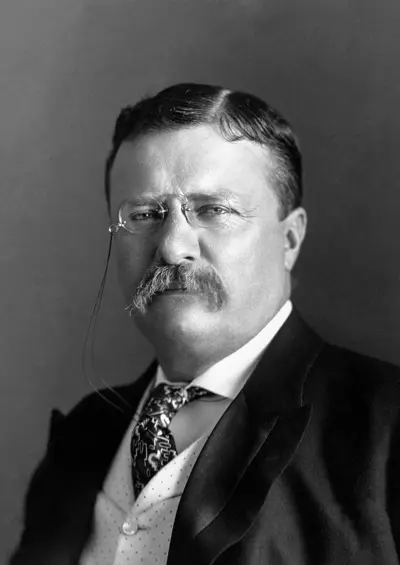
Theodore Roosevelt Jr., often referred to as Teddy or his initials T. R., was an American statesman, conservationist, naturalist, historian, and writer, who served as the 26th president of the United States from 1901 to 1909. He previously served as 33rd governor of New York from 1899 to 1900 and the 25th vice president of the United States from March to September 1901. Roosevelt emerged as a leader of the Republican Party and became a driving force for anti-trust and Progressive policies.
