William McKinley Quotes
If, following the clear precepts of duty, territory falls to us, and the welfare of an alien people requires our guidance and protection, who will shrink from the responsibility, grave though it may be? Can we leave these people, who, by the fortunes of war and our own acts, are helpless and without government, to chaos and anarchy, after we have destroyed the only government they have had? Having destroyed their government, it is the duty of the American people to provide for them a better one. Shall we distrust ourselves, shall we proclaim to the world our inability to give kindly government to oppressed peoples whose future, by the vicissitudes of war is confided to us? We may wish it were otherwise, but it is our duty now ?.
This quotation is one of the best statements reflecting the logic and thinking of a large part of American expansionists and imperialists. Mark Twain and others formed an Anti-Imperialistic League to combat this viewpoint and ideology and both political parties had members on each side of this issue. A little over a century later, we ended up with similar dilemmas regarding nation building in Iraq and Afghanistan after our invasions removed their terrible government. One really notable factor in this quotation is that expansionists like McKinley believed sincerely that imperialism was our DUTY which we could not fairly shirk. That is perhaps the biggest difference between America then and 100 years later.
William McKinley, 1843-1901, 25th President of the United States (Republican, OH), Speech, Banquet of the Board of Trade and Associated Citizens, Savannah, Georgia, December 17, 1898
Sourced by: Eigen's Political and Historical Quotations

She was referring to the aftermath of the Iraq War.


There already was a revolutionary effort of Filipinos to obtain independence from Spain when the U. S. defeated the Spanish in the Spanish American War. The revolutionaries then split. Most trusted the United States and looked to America to help them set up an independent government. Others wanted all foreign forces out. They continued their insurrection against the Americans which produced atrocities on both sides. Finally the insurrection was defeated, and the Philippines have been independent ever since. This quotation was the policy justification that President McKinley used to justify the American involvement in the Philippines after the defeat of Spain.

Even in modern times many politicians the world over agree with Davis’s point that for a government to function well, the nation must have a homogenous citizenship. This is especially true of dictatorships where control of a uniform culture and populous is easier than if it is diverse nation. In modern times, the three greatest economic and scientific powers, the United States, The Soviet Union, and China were and are multicultural societies with different ethnicities, races, religions, and cultures among their sitizenry.


One of his theses was that harsh and cruel government was responsible for a large proportion of troubles in the world.


Despite the fact that there were no formal political polls at the time, public opinion was very influential in curtailing what might be a tendency to use of the American military. Starting with the Cold War later, Presidents tended to use American military force regardless of public opinion or would exaggerate or lie (Vietnam and Iraq wars for example) to temporally gain some public support.
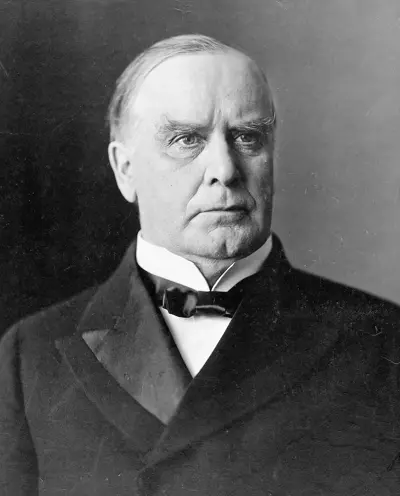
William McKinley was the 25th president of the United States, serving from 1897 until his assassination in 1901. McKinley was president during the Spanish–American War of 1898, raised protective tariffs to boost American industry, and rejected the expansionary monetary policy of free silver, keeping the nation on the gold standard.
