William McKinley Quotes
I went down on my knees and prayed to Almighty God for light and guidance and one night late it came to me this way. We could not leave (the Philippines) to themselves-they were unfit for self-government-and they would soon have anarchy and misrule over there worse than Spain's was. There was nothing left for us to do but take them all and educate the Filipinos, and uplift and Christianize them.
Rusling, James F. "Interview with President William McKinley." The Christian Advocate, vol. 78, 22 Jan. 1903, pp. 137-138.

He had concluded that Spain, who then ruled the Philippines, was incompetent, cruel and immoral in its rule, but that the Filipinos were not educated or sophisticated enough to rule themselves. However, he felt that he had to protect our commercial interests in the islands and the region, and was worried that commercial interests of other countries would take over and control the area. Another reason that this is a very important quotation is that it indicates the anti-Catholic bias in America at the time. Note that the President stated that one objective was to “Christianize” them. However, Spain had been in the islands for over 300 years and most Filipinos were already Roman Catholic. However, Roman Catholics were then a much smaller proportion of the American population and many Protestants didn’t think Catholicism was a legitimate Christian Religion. When the majority of Americans thought of Christianizing other people, they thought of Protestant missionaries much like England. At the time there was very little criticism of the President for the “error” of stating that Filipinos should be Christianized when they were so already Spanish Colonial Policy and Practice was generally terrible and particularly so in the Philippines, See {629450}.

There already was a revolutionary effort of Filipinos to obtain independence from Spain when the U. S. defeated the Spanish in the Spanish American War. The revolutionaries then split. Most trusted the United States and looked to America to help them set up an independent government. Others wanted all foreign forces out. They continued their insurrection against the Americans which produced atrocities on both sides. Finally the insurrection was defeated, and the Philippines have been independent ever since. This quotation was the policy justification that President McKinley used to justify the American involvement in the Philippines after the defeat of Spain.

This quotation is one of the best statements reflecting the logic and thinking of a large part of American expansionists and imperialists. Mark Twain and others formed an Anti-Imperialistic League to combat this viewpoint and ideology and both political parties had members on each side of this issue. A little over a century later, we ended up with similar dilemmas regarding nation building in Iraq and Afghanistan after our invasions removed their terrible government. One really notable factor in this quotation is that expansionists like McKinley believed sincerely that imperialism was our DUTY which we could not fairly shirk. That is perhaps the biggest difference between America then and 100 years later.

In 1898 the President was faced with a great dilemma in the Philippines. Giving the islands back to Spain after the war was unthinkable. Germany and France were waiting to step in. Self government was viewed as impractical, given the state of affairs at the time. The President decided to take the islands.


When it came to war and national honor, TR was a super hawk. His usual subtlety of analysis became gross and binary when war was considered. Opposition was greed and cowardice and never considered policy options.

Den was a liberal reformer. There were many liberal politicians in Japan until the right wing militarists took over. Most Japanese were extremely racist and wanted education to be segregated, not unlike the American South at the time. Den’s action described in this quotation was earthshaking to many Japanese. Integration of the schools was to them bad enough, but assimilating Chinese into the Japanese society was much worse.


Buchanan was then Secretary of State.

American occupation of the Philippines produced great leaps forward in terms of education and political awareness and rights. However, there was not a large improvement on the average standard of living. Economic development lagged. It is interesting to contrast this with the Japanese view of colonialism at the time. See {638280}. For the Japanese, the major objective was economic development, after that perhaps education, and least important were political rights. We were just the opposite in priorities and accomplishments.

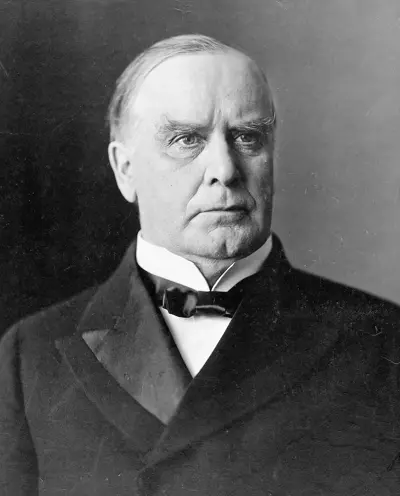
William McKinley was the 25th president of the United States, serving from 1897 until his assassination in 1901. McKinley was president during the Spanish–American War of 1898, raised protective tariffs to boost American industry, and rejected the expansionary monetary policy of free silver, keeping the nation on the gold standard.
