Adam Smith Quotes
For in every country of the world, I believe, the avarice and injustice of princes and sovereign states, abusing the confidence of their subjects, have by degrees diminished the real quantity of metal, which had been originally contained in their coins.
This is a very interesting quotation in that it is one of the first suggestions that money debasement can be caused by a lack of trust and confidence in the government rather than the percentage of precious metals in the coins.
Adam Smith, 1723-1790, Scottish Political Economist, The Wealth of Nations, 1776
Sourced by: Eigen's Political and Historical Quotations


At the time, there was no United States currency. Private banks in some of the states issued their own money. A dollar from Georgia might only be worth 75 cents in New York.

This was a very astute prediction. At the time, the United States gold mining production was second only to South Africa and American currency was based on the gold standard which seemed to all to be permanent. Half a century later, the U. S went off the gold standard.


Conservatives are surprised to learn that their great economic nemesis was one of the early economists who saw the danger of paper money and government control over the minting of money which is one of their core concerns.


This is the first major history of banks written in the United States.


Later, William Jennings Bryan and the Populists turned this point into a major political issue. See Bryan’s Cross of Gold Speech.

When gold and silver were used to make coins, there were dozens of schemes to cheat people. Many of these would be implemented by the official mints (makers of coins) often with the connivance of the ruler who would often get a cut. Davanzati warned princes against debasing the coins on moral as well as pragmatic grounds.

Perry was an extremist politician who commonly exaggerated things to the delight of his supporters and the chagrin of his opponents.

There actually are restraints on how much paper money a government will issue, but unlike with a gold standard where the restraint is external and controlled by how much gold the country can amass. However, with paper money the restraints area all internal. If too much money is printed, the value of the money relative to gold, silver and other nation’s money will go down and imports will become more expensive. Excessive printing of money can easily produce inflation. However, the internal restraints can be overcome by the government’s need to raise money for war, debt or other purposes. So Paul and many other politicians have a deep distrust of paper money not backed by Gold or Silver. In the United States however, the Government does not control the money supply or the printing policies of money. This is under the control of the Federal Reserve Board which while appointed by President’s as terms expire, have a great deal of independence both from the Executive and Legislative Branches. For that reason Paul is even more distrustful when the Federal Reserve decides to print money. See {629491} for his unsuccessful effort to abolish the Federal Reserve Bank.

Stamp was a banker and the 2nd richest man in England at the time. Yet he warned about aspects of banking that needed reform and regulation.

The very act of printing money created a debt—at the time and until the Nixon Administration which went off the gold standard—the government owed the gold or silver and the spicie—the printed money—was a promissory note.

At the time any private bank could issue their own money. Private sector bankers thought it outrageous that the Congress should consider trampling on their rights to issue money. The solution that was finally adopted some years later was to use the Federal Reserve Board to control the money supply. It is independent of the Congress and the President but members are appointed by the President and confirmed by the Senate. Our system, like no other system, is a compromise where neither the Government or the Private Sector controls the American money supply.


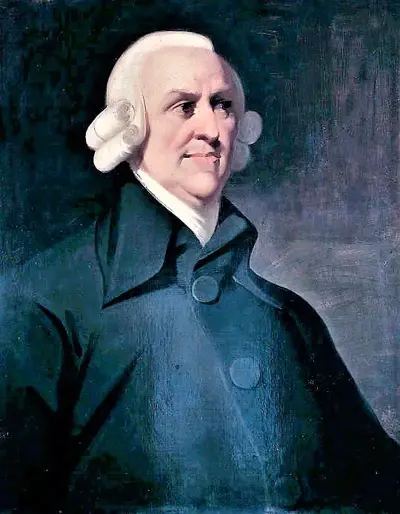
Adam Smith FRSA was a Scottish economist, philosopher as well as a moral philosopher, a pioneer of political economy, and a key figure during the Scottish Enlightenment, also known as ''The Father of Economics'' or ''The Father of Capitalism''. Smith wrote two classic works, The Theory of Moral Sentiments (1759) and An Inquiry into the Nature and Causes of the Wealth of Nations (1776). The latter, often abbreviated as The Wealth of Nations, is considered his magnum opus and the first modern work of economics. In his work, Adam Smith introduced his theory of absolute advantage.
