John Adams Quotes
All the perplexities, confusion and distress in America rise, not from defects in their Constitution or Confederation, not from want of honor or virtue, so much as from downright ignorance of the nature of coin, credit and circulation
John Adams, 1735-1826, 2nd President of the United States (Federalist, MA), Letter to Thomas Jefferson, 1787
Sourced by: Eigen's Political and Historical Quotations


The very act of printing money created a debt—at the time and until the Nixon Administration which went off the gold standard—the government owed the gold or silver and the spicie—the printed money—was a promissory note.


At the time, there was no United States currency. Private banks in some of the states issued their own money. A dollar from Georgia might only be worth 75 cents in New York.


At the time any private bank could issue their own money. Private sector bankers thought it outrageous that the Congress should consider trampling on their rights to issue money. The solution that was finally adopted some years later was to use the Federal Reserve Board to control the money supply. It is independent of the Congress and the President but members are appointed by the President and confirmed by the Senate. Our system, like no other system, is a compromise where neither the Government or the Private Sector controls the American money supply.

This is the first major history of banks written in the United States.

All money has based on the Gold Standard then. But the economic output of the American colonies was increasing rapidly. If the money supply stays fixed, there is a shortage of money and this then inhibits further growth, Franklin realized this and called for an increase in the money supply. He was only 23 years old when he wrote this essay and had these insights.


FDR was then a candidate for the Democratic Vice Presidential Nomination. This statement shocked some of the conservative French and British delegates and officials such as Ramsay MacDonald, Georges Bonnet, and Neville Chamberlain, but economist John Maynard Keynes strongly approved of Roosevelt Roosevelt’s statements. At issue was whether or not the major currency powers should confer frequently and set the international currency exchange rates or should the rates float and be determined at any point by the free market in currency. FDR held the latter view which was opposed to the positions of the conservative banker-oriented delegates from the European counties, However Roosevelt’s statement was considered “harsh” and “vituperative” by the conservatives and the entire conference collapsed over them. FDR admitted that perhaps he had been too strong and blunt in his language. An irony of this quotation is that 80 years later the positions of liberals and conservatives had both flip-flopped. It became the conservatives who adopted the FDR free market for currency exchange while many liberals called for government intervention and agreement on exchange rates to prevent instability.

The sentence was actually drafted by Secretary of the Treasury Salmon Chase.


This is a very interesting quotation in that it is one of the first suggestions that money debasement can be caused by a lack of trust and confidence in the government rather than the percentage of precious metals in the coins.

At the time there was no national paper money. Individual banks printed their own and paper money was not accepted or heavily discounted most Americans. Most opposed a tender law that required paper money to be accepted in commerce.


Attempting to defend charges that his bank and others were engaged in monopolistic practices:


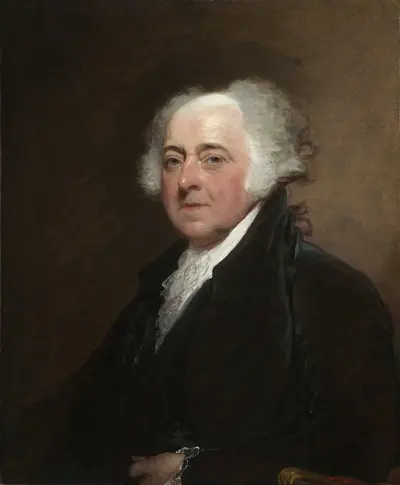
John Adams Jr. was an American statesman, attorney, diplomat, writer, and Founding Father who served as the second president of the United States from 1797 to 1801. Before his presidency, he was a leader of the American Revolution that achieved independence from Great Britain, and he served as the first vice president of the United States. Adams was a dedicated diarist and regularly corresponded with many important figures in early American history, including his wife and adviser Abigail Adams and Thomas Jefferson.
