James Baird Weaver Quotes
Shall we have in this country legal-tender paper issued by the Government, or shall the people depend upon banking corporations for their circulating medium! Shall the Government or the banking corporations control the volume of the currency?
At the time any private bank could issue their own money. Private sector bankers thought it outrageous that the Congress should consider trampling on their rights to issue money. The solution that was finally adopted some years later was to use the Federal Reserve Board to control the money supply. It is independent of the Congress and the President but members are appointed by the President and confirmed by the Senate. Our system, like no other system, is a compromise where neither the Government or the Private Sector controls the American money supply.
James Baird Weaver, 1833–1912, U. S. Congressman Greenback Party, IA), Twice Presidential Candidate, Greenback Party and then The People’s Party (Populists), Speech in the House of Representatives, 1880
Sourced by: Eigen's Political and Historical Quotations

At the time there was no national paper money. Individual banks printed their own and paper money was not accepted or heavily discounted most Americans. Most opposed a tender law that required paper money to be accepted in commerce.

At the time, there was no United States currency. Private banks in some of the states issued their own money. A dollar from Georgia might only be worth 75 cents in New York.


This was a very astute prediction. At the time, the United States gold mining production was second only to South Africa and American currency was based on the gold standard which seemed to all to be permanent. Half a century later, the U. S went off the gold standard.


The alternative would have been for the colonies to borrow English money at high interest rates and use that. Or use money from private banks (which occurred later.) Many conservatives are today a little shocked that some of the American Colonies just printed money with no backing but it worked—at least at the local level. A Boston Bank for example, would take a large commission for a Bostonian to convert Pennsylvania money into Massachusetts money. So it was not a very good system for trade between colonies and International trade. But English money was used for that. The colonists pragmatically got the “best of both worlds” and paid as little interest as they needed to. This system is essentially what we use today on a national scale with no gold or silver backing of the money.


See {583710} for his grandchild’s variation.


America had a difficult early history with money—especially paper money which had been issued by private banks but were trusted by few. Paper money had for the first time had been issued by the Federal Government during the Civil War. Many saw it as a wartime measure but not a good practice to follow. Garfield, along with many other leaders thought that it was not constitutional for Congress to issue paper money. Others prevailed as the need for a lighter and more practical form of currency was necessitated by a growing economy. Coins for large transactions between businesses especially was very awkward when chests of coins had to be delivered to pay for cattle, produce or manufactured goods at the wholesale level.


There actually are restraints on how much paper money a government will issue, but unlike with a gold standard where the restraint is external and controlled by how much gold the country can amass. However, with paper money the restraints area all internal. If too much money is printed, the value of the money relative to gold, silver and other nation’s money will go down and imports will become more expensive. Excessive printing of money can easily produce inflation. However, the internal restraints can be overcome by the government’s need to raise money for war, debt or other purposes. So Paul and many other politicians have a deep distrust of paper money not backed by Gold or Silver. In the United States however, the Government does not control the money supply or the printing policies of money. This is under the control of the Federal Reserve Board which while appointed by President’s as terms expire, have a great deal of independence both from the Executive and Legislative Branches. For that reason Paul is even more distrustful when the Federal Reserve decides to print money. See {629491} for his unsuccessful effort to abolish the Federal Reserve Bank.

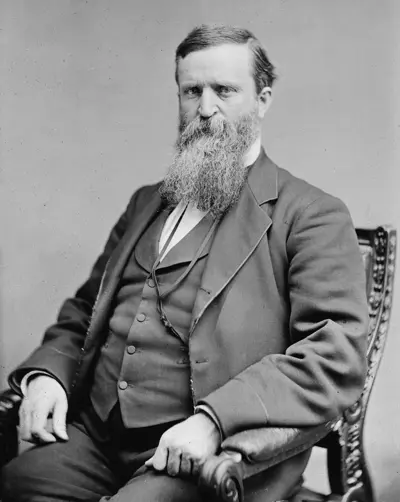
James Baird Weaver was a member of the United States House of Representatives and two-time candidate for President of the United States. Born in Ohio, he moved to Iowa as a boy when his family claimed a homestead on the frontier. He became politically active as a young man and was an advocate for farmers and laborers. He joined and quit several political parties in the furtherance of the progressive causes in which he believed. After serving in the Union Army in the American Civil War, Weaver returned to Iowa and worked for the election of Republican candidates. After several unsuccessful attempts at Republican nominations to various offices, and growing dissatisfied with the conservative wing of the party, in 1877 Weaver switched to the Greenback Party, which supported increasing the money supply and regulating big business. As a Greenbacker with Democratic support, Weaver won election to the House in 1878.
