Andrew Jackson Quotes
Corrupt Bargain
No one had a majority of the Electoral College and the election was thrown into the House of Representatives. Henry Clay was the Speaker of the House, and had a grudge against Jackson. He convinced several of the State congressional delegations to vote for John Quincy Adams, and when Adams was President, he made Clay the Secretary of State, then the most powerful cabinet position. Hence Jackson’s characterization.
Andrew Jackson, 1767-1845, 7th President of the United States (Democrat, TN), Description of the election of 1824, 1824
Sourced by: Eigen's Political and Historical Quotations


Alluding to the many scandals of the Reagan administration:

In the razor thin 2000 Presidential election the Republican controlled Florida legislator called a special session to name their own electors to go to the electoral college. The Governor, Jeb Bush, was the brother of the Republican candidate.

In the 1824 presidential election Jackson won a plurality of popular and electoral votes but not a majority. The election was thrown into the House of Representatives where Speaker Henry Clay cut a deal with John Quincy Adams who had finished second. Adams became President and Clay, Secretary of State.


Bribing Congressmen was quite common. In those days, money to Congressmen and Senators was not even disguised as campaign contributions. The letters were the short terms for the different agents.


Editorializing on Daniel D. Rostenkowski, U. S. Congressman (Democrat, IL) and Chairman of the House Ways and Means Committee:

She was the first Black woman to be elected to Congress and was the first Black woman to actively campaign for the Presidency

Recommending campaign strategy to erstwhile politicians:


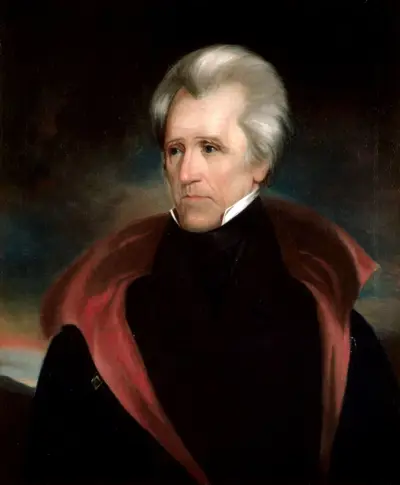
Andrew Jackson was an American lawyer, soldier, and statesman who served as the seventh president of the United States from 1829 to 1837. Before being elected to the presidency, Jackson gained fame as a general in the United States Army and served in both houses of the U.S. Congress. An expansionist president, Jackson sought to advance the rights of the "common man" against a "corrupt aristocracy" and to preserve the Union.
