Lyndon B. Johnson Quotes
What a President says and thinks is not worth five cents unless he has the people and Congress behind him. Without the Congress I'm just a six-feet-four Texan. With the Congress I'm President of the United States in the fullest sense.
Lyndon Baines Johnson, 1908-1973, 36th President of the United States (Democrat, TX), Remark to Abba Eban, 1967
Sourced by: Eigen's Political and Historical Quotations


Referring to President Bush's winning a roll-call vote in the House on lowering the capital gains tax:


President Abraham Lincoln had pocket vetoed his own party's reconstruction bill in the midst of an election year.


When John Erlichmann claimed that President Nixon could break and enter and burglarize in the name of national security, the chairman of the investigation replied:


This was the President’s original role regarding legislation. However, in the 20th century, Presidents have become more active and suggest laws and often initiate the process and then end it by signing the law that he suggested and shepherded through the Congress. But this was never the vision of the Founding Fathers, but since it is not addressed in the Constitution is not an unconstitutional process.

President George W. Bush initiated an invasion of Iraq based on the fact that Iraq was developing nuclear, chemical and biological weapons. After the invasion however, there were none of these weapons found and much evidence that there were not any at that point in time. By the time Congress, the body which is supposed to declare war, found out that the reason for the war was bogus, it was too late. We had already occupied the country and were in the midst of a civil war. The President either acted on bad intelligence or wanted to invade Iraq for other reasons and history may finally tell us which, but Fein sees the problem as too much secrecy in the executive branch.


When the Senate was debating the Gulf of Tonkin Resolution, which would empower the President to take "all necessary measures" to repel any armed attack on U. S. forces, Senator Morse was one of only two Senators opposing the resolution:

The Supreme Court had decided to hear an important case on gun rights. Cheney discovered that Solicitor General, the Administration’s chief lawyer before the Supreme Court, Paul Clement planned to file a brief that was very different from Cheney’s own personal views. In protest, he signed his name to a much stronger brief filed by 55 pro-gun senators and 250 members of the House of Representatives. The President’s Chief of Staff called Cheney on the carpet for doing something that was unforgivable—the Vice President had publicly criticized the position that the President’s (and the Vice President’s) chief lawyer was taking. This was Cheney’s excuse—ie that he was not protesting as the Vice President but as President of the Senate, the only other Constitutional Role of the Vice President. Bolton let the vice president know that if he ever tried something like this again, he would be frozen out of most government activities. See {633772} . In Bush’s second term Cheney had less and less influence, in part because of his unethical behavior like this.


This is a very important historical quotation because it clearly stated the left wing view of regulation. Large Business had been so unethical and illegal at the time that the majority of Americans and Congress, together with a Republican President, thought that it would be good to “weld” the growth and development of large companies to the Government. The right wing saw this as extreme Communism. Over time, when corporate greed and excesses had been controlled by government and was not as prevalent, the inhibition on growth and development of welding corporations to Government was recognized and a period of deregulation followed with most Americans not wanting to allow large companies to be completely deregulated and also not wanting them welded to the government. The extent of regulation has been the political contest with the extreme left and extreme right still holding to their ideological positions and sometimes paralyzing the middle as in the Obama administration.


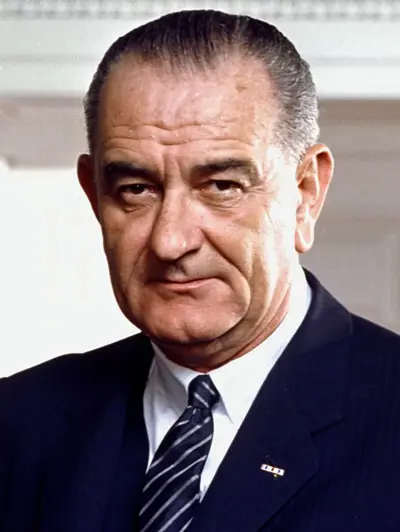
Lyndon Baines Johnson, often referred to by his initials LBJ, was the 36th president of the United States, in office from 1963 to 1969. He served as the 37th vice president from 1961 to 1963 and assumed the presidency following the assassination of President John F. Kennedy. A Democrat from Texas, Johnson was also a United States representative and later majority leader in the United States Senate. Johnson is one of only four people to have served, at various times, in all four federal elected positions.
