James Monroe Quotes
The President does indeed hold the rudder of the Ship of State; he guides, but it is American public opinion which makes the vessel move.
Monroe was then Secretary of State.
James Monroe, 1758-1831, 5th President of the United States (Democratic Republican, VA), Statement to the French Ambassador, 1811
Sourced by: Eigen's Political and Historical Quotations

President George W. Bush initiated an invasion of Iraq based on the fact that Iraq was developing nuclear, chemical and biological weapons. After the invasion however, there were none of these weapons found and much evidence that there were not any at that point in time. By the time Congress, the body which is supposed to declare war, found out that the reason for the war was bogus, it was too late. We had already occupied the country and were in the midst of a civil war. The President either acted on bad intelligence or wanted to invade Iraq for other reasons and history may finally tell us which, but Fein sees the problem as too much secrecy in the executive branch.


This point of view is contentious in that many people (usually those at the extreme left and extreme right) think that the intention of the founding fathers was to avoid a single executive from starting a war unilaterally. Congress was given the power to declare war—not the president. Arguably public opinion is reflected by Congress, but going to war, when public opinion has been opposed to it has always turned out badly in American History.


Although Hamilton was an advocate of a strong Federal Government, he always advocated checks and balances. Here, he called for checks on the President in the area of foreign affairs which he thought was lacking in the draft of our original constitution. His concern was not addressed and the President still has almost unilateral control over American foreign policy. The only checks are the Senate with the power to ratify treaties or not, and the Congress which need not appropriate money for purposes that the President thinks important, and can condition the money that they do appropriate upon certain limitations on the President’s preferred policies.


The Supreme Court had decided to hear an important case on gun rights. Cheney discovered that Solicitor General, the Administration’s chief lawyer before the Supreme Court, Paul Clement planned to file a brief that was very different from Cheney’s own personal views. In protest, he signed his name to a much stronger brief filed by 55 pro-gun senators and 250 members of the House of Representatives. The President’s Chief of Staff called Cheney on the carpet for doing something that was unforgivable—the Vice President had publicly criticized the position that the President’s (and the Vice President’s) chief lawyer was taking. This was Cheney’s excuse—ie that he was not protesting as the Vice President but as President of the Senate, the only other Constitutional Role of the Vice President. Bolton let the vice president know that if he ever tried something like this again, he would be frozen out of most government activities. See {633772} . In Bush’s second term Cheney had less and less influence, in part because of his unethical behavior like this.


Mencken was a brilliant and funny but pompous snob who had little respect for the average person.
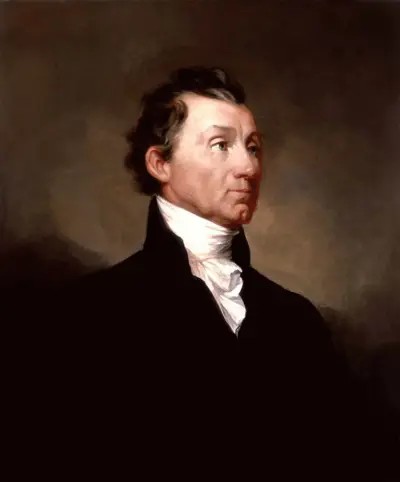
James Monroe was an American statesman, lawyer, diplomat and Founding Father who served as the fifth president of the United States from 1817 to 1825. A member of the Democratic-Republican Party, Monroe was the last president of the Virginia dynasty; his presidency coincided with the Era of Good Feelings. He is perhaps best known for issuing the Monroe Doctrine, a policy of opposing European colonialism in the Americas. He also served as the governor of Virginia, a member of the United States Senate, the U.S. ambassador to France and Britain, the seventh Secretary of State, and the eighth Secretary of War.
