Walter Lippmann Quotes
We have not found a way to give Congress control without depriving the President of essential power.
Walter Lippmann, 1889-1974, Political Columnist, Quoted in A. N. Holcombe, Our More Perfect Union, 1950
Sourced by: Eigen's Political and Historical Quotations


Bybee, then and Assistant Attorney General, took the legal position that the President could order the torture of enemy combatants regardless of Congressional laws prohibiting torture. Two years later the memo’s recipient, Alberto Gonzalez, in his confirmation hearings as Attorney General, repudiated the memo, then stating that the President was not above the law and had to obey the laws of Congress that apply to the military.


When the Senate was debating the Gulf of Tonkin Resolution, which would empower the President to take "all necessary measures" to repel any armed attack on U. S. forces, Senator Morse was one of only two Senators opposing the resolution:

This notion seems to have first been expressed by Edward S. Corwin in 1940

This was the President’s original role regarding legislation. However, in the 20th century, Presidents have become more active and suggest laws and often initiate the process and then end it by signing the law that he suggested and shepherded through the Congress. But this was never the vision of the Founding Fathers, but since it is not addressed in the Constitution is not an unconstitutional process.

Alberto Gonzalez, White House Counsel and later Attorney General who was forced to resign and David S. Addington, Counsel to the Vice President, had come up with a novel view of the powers of the presidency. They argued that since the President is the Commander in Chief, in a war situation or intelligence gathering thereto, has the Constitutional responsibility for that function, he need not obey any laws of Congress as in the conduct of the war Congress would be impinging on the Constitutional separation of powers which itself was prohibited by the Constitution. The argument did not find any significant legal support but for a while the George W. Bush White House behaved as if this were the law, despite the fact that even in the American Revolution and the War of 1812 Congress passed laws regulating the conduct of the armed forces as is provided for in other parts of the Constitution. Yet even Goldsmith would allow the President some powers that many think are unconstitutional and/or belong to Congress. See {32436}.


His role was the equivalent of the Mayor of Washington DC. Even though the Congress had generally been the most powerful branch of the government, public opinion on this was beginning to shift at the turn of the 20th century.


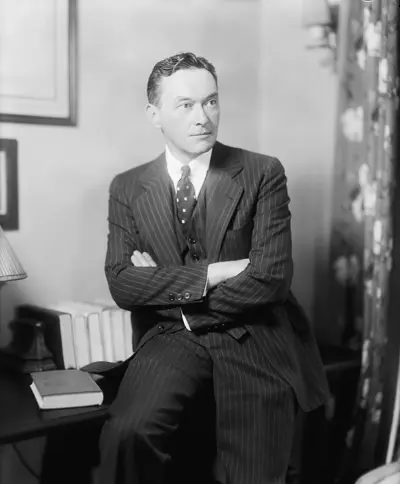
Walter Lippmann was an American writer, reporter and political commentator. With a career spanning 60 years he is famous for being among the first to introduce the concept of Cold War, coining the term "stereotype" in the modern psychological meaning, as well as critiquing media and democracy in his newspaper column and several books, most notably his 1922 book Public Opinion.
