Andrew Jackson Quotes
The Union: It must be preserved.
At the time his Vice President, John C. Calhoun, was expounding a theory of “nullification” by which the states could supersede and nullify federal law in their states. When Jackson finished his toast, it was Calhoun’s turn (See {635896}.) His toast supported the States’ Rights position over the federal government. In those days Presidents and Vice President’s were often political enemies or of opposite parties. The President’s advisors thought that his toast might be misinterpreted. So when they gave the toast to the press as “The Federal Union: It must be preserved.” That was the form in which the press reported the President’s toast and for many years that was the version most quoted even though it was never delivered that way. However Jackson was responsible for both versions.
Andrew Jackson, 1767-1845, 7th President of the United States (Democrat, TN), Toast at a Jefferson Day Dinner, April 13, 1830
Sourced by: Eigen's Political and Historical Quotations

The Vice President and the President were at odds over the theory of “nullification” by which the states could supersede and nullify federal law of action in their states. The President had just given a toast to the Preservation of the Union (See {587324}). So Calhoun embellished upon it and gave this toast. The President then strengthened the version of his toast that was given to the press so that it was clear that he did not support his Vice President’s position on nullicication.

The words are those of President Andrew Jackson. See {604550}. After occupying New Orleans, General Butler infuriated the Confederate Sympathizers with this act. Jackson was the hero of the Battle of New Orleans and an unapologetic slave owner. The Southerners had erected a magnificent statue of their hero Jackson on horseback in a major section of the city. Butler, then ordered that the Jackson quotation be chiseled in the stone base. The townspeople were furious that this Union General would make up words and attribute them to Jackson; however, when they finally realized that Jackson had actually said those words they felt even more humiliated. There are still a few Southernors who consider this terrible insult to the Confederacy, and of course that is just what Butler intended.


Jackson makes the case against the South Carolina argument for nullification. In the related quote, he makes his threat which was very successful in ending the notion of “nullification”. The extensive quotation is given as it summarizes the entire issue that was one of the crises of early America.

Seward, the newly appointed Secretary of State was extremely concerned that if the radical direction that many of the Southern States were moving in turned into a Civil War, that the Union should not be seen as the precipitating initiator. His policy was followed and the secessionist extremists, not so politically sensitive, attacked Fort Sumter and became the initiator of the war so far as public opinion was concerned domestically and internationally. It was very important for the Union effort that the Confederates by seen as a group of radicals rebelling against the authority of a legitimate state. If that was the case, any effort to aid or help the South could be seen as an unfriendly act of war against the United States. Conversely, the South would have liked to be seen as an independent nation, no longer connected to the United States and entitled to diplomatic relations and foreign trade with all other nations. But the attack on Fort Sumter made that position much harder to maintain.


Bragg and other Southerner leaders had an unusual concept of equality. Ever since the original Constitution, Northerner’s votes counted for themselves only while a single Southerner’s vote counted for all his slaves as well. So the individual Southerner always had more political power than his Northern counterpart. However, this notion of equality reached it’s acme when it came to the new territories. The Southern argument was that Southerners could not equally prosper in the new territories of Kansas and Nebraska if they could not bring their slaves to work the land. The thought that Southerners were equally able to personally work the new lands or pay labor seems to never have occurred to them. If Northerners could prosper that way then Southerners should be equally able to do so also. However, many Southern whites simply could not conceive of a “gentleman” working in the fields. Therefore they would not be equally able to prosper in the new territories.


Maryland was the last state to ratify the Articles of Confederation, not doing so until March 1, 1781.

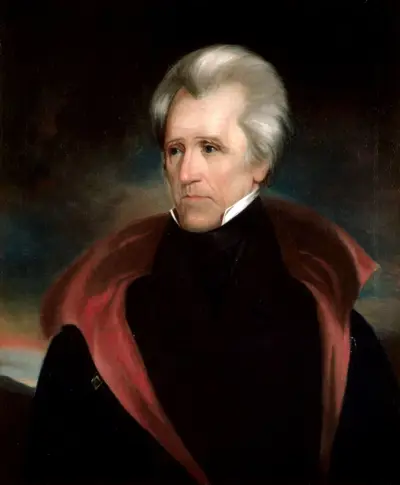
- Born: March 15, 1767
- Died: June 8, 1845
- Nationality: American
- Profession: President
Andrew Jackson was an American lawyer, soldier, and statesman who served as the seventh president of the United States from 1829 to 1837. Before being elected to the presidency, Jackson gained fame as a general in the United States Army and served in both houses of the U.S. Congress. An expansionist president, Jackson sought to advance the rights of the "common man" against a "corrupt aristocracy" and to preserve the Union.
