Theodore Roosevelt Quotes
The Supreme Court is a menace to the welfare of the nation.
TR had a Supreme Court where a conservative block was in the majority and declared a number of his key reforms as unconstitutional. The same thing happened to FDR as well. Since Supreme Court justices had lifetime tenure most presidents and congresses have to deal with a court that has the political makeup and political philosophy of previous administrations by which they were appointed. Reform and change presidents tend to see the Supreme Court as obstructionist.
Theodore Roosevelt, 1858-1919, 26th President of the United States (Republican, NY), Characterization of the Supreme Court, Quoted in Albert Gore Jr., The Future: Six Drivers of Global Change, 2013
Sourced by: Eigen's Political and Historical Quotations


The Roosevelt administration had stemmed the tide of Hoover’s Great Depression but the nation had not yet recovered. The New Deal measures, most of which would be considered fundamental to good government 50 years later was being constantly thwarted by a Supreme Court with a strong arch conservative majority headed by James McReynolds, a virulent, overt, anti-Semitic racist, who hated FDR—see {616652} and {585241}. The situation was to many like that which existed before the Civil War when the Court rendered the Dred Scott decision that so harmed the nation. Frankfurter, not then a Supreme Court Justice, urged Roosevelt to do something lest the American Public lose all respect for the Court and our Constitutional system and have the nation harmed by not allowing reforms like child labor laws to go through. The court actually ruled by a narrow majority that the government could not pass laws making it illegal for 11 year old children to work in coal mines or factories. FDR attempted to add more justices turning the majority into a majority—“packing the Supreme Court”, but that politically backfired. Some of the reforms never went through while others needed Constitutional Amendments like the end to Prohibition.


It is argued whether Scalia’s problem was that the Supreme Court was doing something new or radical or the country had changed. He had certainly lived through the greatest transformation of any society and culture on earth at a pace of change that far exceeds anything that has occurred before. Scalia is one who believes that the Constitution should not be interpreted in recognition of these changes, but should be immutable as it was written for the late 18th century. Most judges and legal scholars disagree and try to interpret the Constitution as the founders would have intended, knowing what we know, having the tools and powers we have, and facing the problems of the modern world. It represents a major legal and philosophical debate.

Bork was the proponent of the theory that the Supreme Court constantly exceeded its authority and became a de facto legislature to make reforms the elite, intellectual elements of society desired as opposed to what the majority wanted.

The reference was to the Presidential power to appoint Supreme Court Justices who will serve beyond his term.


David Souter was an outstanding Supreme Court Justice—a lifelong Republican appointed by a Republican President. He did not vote the way Erickson thought he should. There was never any hint of any kind of sexual problem with Souter, and why Erickson chose to slander him with these descriptors is not known. One unproven theory is that some Souter votes and opinions upheld the First Amendment freedoms of pornographers and therefore by supporting these practices being promulgated, Erickson thought that he believed they were worthy themselves. Fortunately, Souter was so well thought off that only a few right wing extremists took these lies for what they were. What is important about this quotation is that Erickson did not lose any standing within the Conservative wing of the Republican party as a result of these rash slanders that were in themselves in terrible taste and crudely expressed. The Daily Telegraph of London put Erickson on its "List of Most Influential US Conservatives", giving him a rank of 69th most influential in 2007 and 65th in 2010. This crude lie was made in 2009. The Republican Party traditionally would never tolerate this kind of rhetoric but after the Southern Strategy, the party grew more and more extremist in its views and more and more vicious and unethical in its political methods.


This was an insult to the George W. Bush administration which had stretched the Constitution more so than any previous administration, had asserted Presidential powers that had never been asserted before and had had several of its more controversial policies and practices overturned by the Supreme Court.


Jefferson’s fears were later reinforced by John Marshall in Marbury v. Madison {606468}
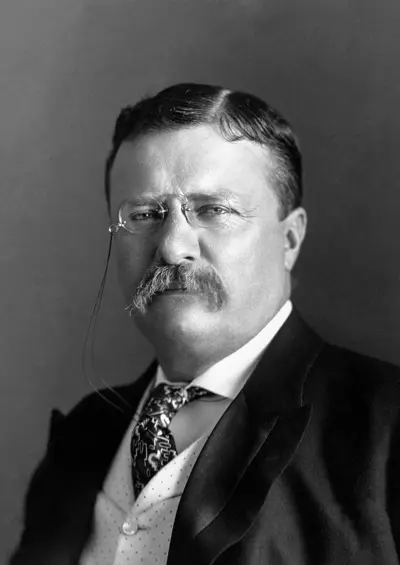
Theodore Roosevelt Jr., often referred to as Teddy or his initials T. R., was an American statesman, conservationist, naturalist, historian, and writer, who served as the 26th president of the United States from 1901 to 1909. He previously served as 33rd governor of New York from 1899 to 1900 and the 25th vice president of the United States from March to September 1901. Roosevelt emerged as a leader of the Republican Party and became a driving force for anti-trust and Progressive policies.
