James Buchanan Quotes
The present Administration had no alternative but to accept the war initiated by South Carolina or the Southern Confederacy. The North will sustain the Administration almost to a man, and it ought to sustain it at all hazards.
James Buchanan, 1791-1868, 15th President of the United States (Democrat, PA), Letter to John A. Dix, March 8, 1961
Sourced by: Eigen's Political and Historical Quotations


After the Presidential years of James Buchanan who protected the South from slavery reform and abolition as the North was gaining political power and the abolitionists were having a greater and greater effect on public opinion in the North. While Southerners did not believe Lincoln would emancipate the slaves, they realized that the majority of the growing nation was opposed to slavery, and more and more Northern states were passimg laws making any slave who sets foot in the State a free person. Slaves coud not only have more reason to run away, but slave owners would not be able to get their “property” back. Lincoln would not help the South as Buchanan did, and the Southerners realized that over time, slavery would no longer be feasible or profitable. Cobb, very experienced at Washington politics, realized the changes that would come and thought that they would be “certain and speedy.” The irony was that if the South had not seceded and simply dragged its feet legislatively, it would have taken two or three decades for slavery to end. However, by seceding and initially fighting so hard and well while poor Union generals were in command, Lincoln was forced to try more drastic measures and issued the Emancipation Proclamation after only a few years. The Civil War and seccession was not only a tactical and strategic error for the South, but rapidly brought about just what the Southerners were fighting to prevent.

More new technology was deployed in the Civil War than any other war in history and Moltke did not realize that the classic European military tactics were obsoleted. However, neither did most of the Southern Generals and many of the Union Generals. Lincoln, Grant and Sherman were the ones who developed strategies and tactics to function in the new world of warfare.


The South had attacked Fort Sumter

While Douglas and Lincoln were political opponents with little love lost between them, both were patriots. Douglas’s position were much more popular in the South, and the moment he realized that Lincoln would win the Presidency, he headed South where he was very persuasive in trying to hold the Union together, but he could not see all the potential rebels and was only effective with some. South Carolina not only seceded, but in order to prevent any changing of minds, some the worst of the South Carolinians, attacked Fort Sumter firing on the American Flag and attacking and capturing the Union troops who were totally outnumbered. The Civil War was then inevitable.

The American Civil War was followed by intellectuals throughout the world. Most were offended by the immorality of the slavery that the South was fighting to maintain, but admired the way they organized and fought for their principles.


He stated that he had a vision and made these two prophesies that indeed came true. The first was the South Carolina secession starting the Civil War. The second, when the North used former slaves as soldiers who fought their old masters.


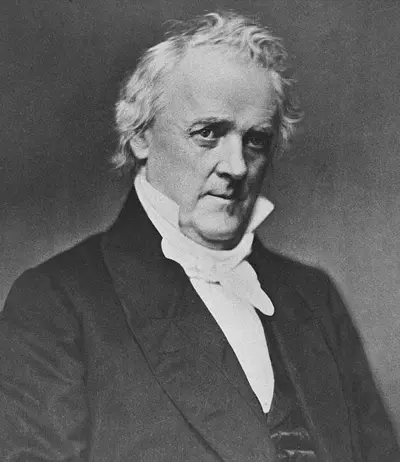
James Buchanan, Jr. was the 15th President of the United States (1857–61), serving immediately prior to the American Civil War. He represented Pennsylvania in the United States House of Representatives and later the Senate, then served as Minister to Russia under President Andrew Jackson. He was named Secretary of State under President James K. Polk, and as of 2016[update] is the last former Secretary of State to serve as President of the United States. After Buchanan turned down an offer to sit on the Supreme Court, President Franklin Pierce appointed him Ambassador to the United Kingdom, in which capacity he helped draft the Ostend Manifesto.; James McGill Buchanan, Jr. was an American economist known for his work on public choice theory (included in his most famous work The Calculus of Consent), for which he received the Nobel Memorial Prize in 1986. Buchanan's work initiated research on how politicians' and bureaucrats' self-interest, utility maximization and other non-wealth maximizing considerations affect their decision making. He was a member of the Board of Advisors of The Independent Institute, a member (and for a time the President) of the Mont Pelerin Society, a Distinguished Senior Fellow of the Cato Institute, and professor at George Mason University.
