L. Frank Baum Quotes
The Pioneer has before declared that our only safety depends upon the total extermination of the Indians. Having wronged them for centuries we had better, in order to protect our civilization, follow it up by one more wrong and wipe these untamed and untamable creatures from the face of the earth. In this lies future safety for our settlers and the soldiers who are under incompetent commands. Otherwise, we may expect future years to be as full of trouble with the redskins as those have been in the past. .
This editorial was written just after the Massacre of Wounded Knee. An irony is that this editor who called for the extermination of Native Americans was later the author of The Wizard of Oz.
L. Frank Baum, 1856-1919, Newspaper Editor & Author, Editorial, The Aberdeen Pioneer, January 3, 1891
Sourced by: Eigen's Political and Historical Quotations

In April 1832, Black Hawk led his warriors into Illinois to recapture their ancestral lands. The attempt was thwarted by American Army and Navy forces, and Black Hawk surrendered. Several months later he was sent East to meet with President Andrew Jackson. At that meeting, Black Hawk told the President:


The first Native American to become a General Officer. Appointed by President Grant in 1869

Oliver was the judge who tried the British Soldiers after the Boston Massacre. Most Americans believe that scalping was an Indian barbarity. Although it was new to the European colonists who came to America, they quickly adopted the practice and had similar cultural and macho symbols associated with scalps. This is one of the many eyewitness descriptions of the Whites and their scalping. The barbarity was practiced by White and Indian alike.


The officer who testified at the inquiry of the Sand Creek Massacre, Lieutenant Joseph Cramer, was murdered thereafter in Denver by a supporter of Chivington’s. Sand Creek’s Indians were mutilated even after death with breasts and scrotums cut off as souvenir tobacco pouches. Ironically, President Lincoln had med with some of the killed Cheyenne leaders at the White House the year before and his quotation presages those whites who would break treaty.


Most of the Iroquois, under the influence of Joseph Bryant, thought that the English would be the winner in the American Revolution. With the exception of the Huron Tribe, the Iroquois sided with the English. Washington developed a policy of what we call today “ethnic cleansing” and successfully chased the other 5 Iroquois tribes out of their traditional lands and to safety in Canada where their descendents still live.

Wayne played so many parts depicting whites in the process of expanding Westward that many people saw him as an expert on the history of the Westward Expansion. He did not comment on the whites who then kept huge ranches “selfishly” for themselves or those who selfishly would not share the mineral rich land that they had taken with anyone including the original Indian owners. So in this view, the Indians should have not been capitalists but they should have been socialists and shared their resources.

Gold had been discovered in the Black Hills lands that were sacred to the Lakota Sioux and were reserved for exclusive use of the Indians by the Fort Laramie Treaty. Greedy whites, ignoring the treaty provisions not only entered the Black Hills to pan and mine for the gold, but killed many Indians they ran across Sherman was angry and wrote to his old friend President Grant. Grant, now a political, had to contend with public opinion that thought it absurd that gold should not be mined because a few Indians regarded the land as sacred. Meanwhile Grant was working with a few others to portray minor clashes between whites and Indians in the Black Hills as violent and dangerous Indians breaking the treaty.

White Africaners were slaughtering Blacks to appropriate their land in violation of English law. See {583901} for a related quotation.
Over the years Sherman’s advocacy of Indian extermination went beyond the Sioux to all Indians.


The Indian allies of the French scalped some American colonists which for some whites was akin to the modern reaction to terrorist atrocities. The British and Americans then justified the scalping of their Indian allies as simple retaliation. While Indians had scalped before the whites ever came, the whites accelerated the practice. There was an economic element to scalping. The French “paid” their Indian allies in arms, blankets, trinkets and alcohol by the scalp as it was a crude way of “performance measurement.” Not to be outdone, the English adopted the same custom with the French allied Indians as targets. In North Carolina, for example, the “volunteer” rangers were paid the enormous rate of 10 pounds a scalp.


Hull surrendered a few days later.

The rationale for paying these Indians was given in the beginning of the treaty. See {612283}. In addition the treaty provided for the Federal government to build a flour mill and a saw mill and provide technical staff to operate and maintain them. In an interesting gesture the Federal government rebuilt a church that had been the house of worship for some Oneida Presbyterians. The English and the other Iroquois had burned the church to the ground. See {621968}. This is one of the few times in history, and certainly the first time, that the Federal government constructed a church for a particular sect. The other tribes of the Iroquois nation had allied themselves with the English. See {583726}. Only the Oneida joined the colonist cause. At the end of the war, the other Iroquois tribes were run out of the country and they escaped to Canada. The Oneida, in contrast, were rewarded by the Federal government and integrated into New York State society.
The quotation is actually combined from two different speeches, July 28 and August 21, 1725. The dependency on guns and gunpowder was one of the key elements that was creating the dependency. See {613048}.
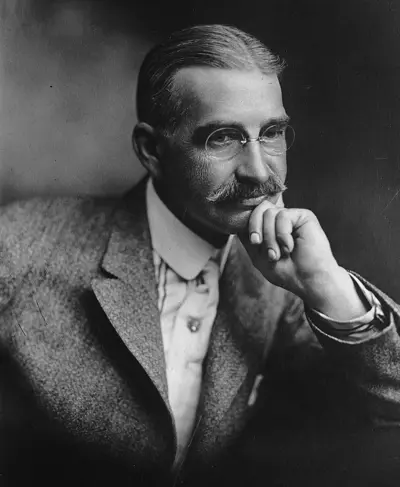
Lyman Frank Baum was an American author best known for his children's books, particularly The Wonderful Wizard of Oz and its sequels. He wrote 14 novels in the Oz series, plus 41 other novels (not including four lost, unpublished novels), 83 short stories, over 200 poems, and at least 42 scripts. He made numerous attempts to bring his works to the stage and screen; the 1939 adaptation of the first Oz book became a landmark of 20th-century cinema.
