John Toland Quotes
Hitler's concept of concentration camps as well as the practicality of genocide owed much, so he claimed, to his studies of English and United States history. He admired the camps for Boer prisoners in South Africa and for the Indians in the Wild West; and often praised to his inner circle the efficiency of America's extermination--by starvation and uneven combat--of the 'Red Savages' who could not be tamed by captivity
John Toland, 1912-2004, Historian, Adolf Hitler
Sourced by: Eigen's Political and Historical Quotations

White Africaners were slaughtering Blacks to appropriate their land in violation of English law. See {583901} for a related quotation.


He was a viscious anti-Semite who attracted to his party extreme right wingers, Nazi Sympathers and apologists for the Vichey Franch government. The party was rejected by the majority of French voters, but when his daughter took over the party, she was not an anti Semite but foudn it hard to shake the party's image which was alaysa associated with her name even when she actually kicked her father out of the party.


The historical record that is available shows that while the Pope did not, actively or aggressively oppose Hitler, and he did not discipline Catholic prelates who were Nazi supporters, there is no specific evidence that shows the Pope conspired with Hitler, about the extermination of Jews or anything else. However, most of the relevant documents of the era are in the Vatican and the records have been sealed and have not been visible to historians. Apologists for the Pope’s passivity point out that a large percentage of Germans were Catholic and he had a duty to not antagonize Hitler who would retaliate against German Catholics and the German Catholic clergy and church property. Further, Fascist Italy was under Hitler’s control, and the Vatican itself could have closed and its property seized. The historical record is still very vague.
The White Boers viewed themselves as superior to the Blacks and the Blacks and Whites competed for land. In an early form of ethnic cleansing, the Boers attacked the undefended women and children of the Black tribes. The authorities opposed these atrocities but did not have any way of enforcing their orders.

The allies—mostly under American Pressure—only tried the highest ranking Nazi war criminals. Many wanted to try the rest, but they did not prevail. Lord Russell, the English prosecutor at Nuremburg resigned in protest as he had case files on over 100,000 Nazi war criminals who were never prosecuted. The main object was to use those officials to establish a strong anti-Communist government in post war Germany.

Many German officials, after the war, tried to justify the Concentration Camps. However, the argument has little historical merit as by the time the Nazis implemented them, they had complete control of the country and were in no danger of Civil War. And certainly the torture, medical experiments, and murders were not required to prevent civil strife. And using inmates as slave laborers in Donitz’s shipyards had nothing to do with civil war. After the war Donitz was found guilty of Unrestricted Submarine Warfare and using thousands of slave laborers in his shipyards. He was sentenced to 10 years, one of the lightest sentences if the German War Crimes Trials. He himself was not only an enthusiast about the concentration camps but was a murderous anti-Semite as well. See {624978}. The thought that the Germans had to kill little children to avoid civil war is as absurd as any argument could be.

At the time, Jefferson was the Governor of Virginia and the Indians and white settlers in the Western part of the state were coming into increasing conflict. This rather heartless and blood thirsty quotation of Jefferson’s surprises many of his great admirers. Especially because of his historical sophisticated and empathetic way he treated Indians. See {589102}, {589103}, {589113}, {589125}, and {605068}. Jefferson saw Indians much like he saw whites—differentially. Some were friends, some neutral, and some dangerous enemies. His wish to exterminate or ethnically cleanse these Indians was limited to these Indians—not to Indians in general. Nonetheless, it shows a violent side of Jefferson that was in play with enemies. As President, he was aggressive against the Muslim Pirates (see {623707} and {617123}).


This quotation distressed many ultra rightists who otherwise were avid followers of Mises. See {632407} for another quotation that distressed many European conservative devotees of Mises.

The Boers were lower class, uneducated, farmers from Holland who came to South Africa before the English did. They were at the bottom of the Dutch socioeconomic ladder. Unlike the English who were interest in establishing a trading colony, the Boers just wanted to own and farm the land and use blacks as slave or cheap labor. The Dutch Government and Trading companies lost interest in South Africa as there were much more profitable parts of the world, and they felt no obligation to the Boers whom they were glad to be rid of. So the Boers found themselves having to follow the British laws and rules of the British Colonial Office. Slavery was outlawed, and Blacks could be educated and become citizens under British law. They could own land, and contest the right of the Boers who had settled in some uninhabited land and some that was owned by Black tribes. The Blacks outnumbered the whites in general and the Boers, and there were educated Blacks who “outclassed” the still relatively uneducated Boers. So the Boers, fighting for their “way of life” set up their own area in Southern Africa and claimed independence. But Blacks claimed that it was their land and looked to the British to exercise English law. The Boer war ensued. Although the Boers lost the war, the bred at a much faster rate than the English, many of whom did not even have their families in South Africa. By the end of WWII, the Boer white majority controlled the government and kept the majority Blacks from voting and having full citizenship rights. They dominated Apartheid South Africa until the Black Revolutionists obtained control and although Black and white relations are better in South Africa than most countries, the extemeist Boers and most militant Blacks are in political, but not violent, conflict. Churchill and the British have always perceived themselves as being caught in the middle between the Boers and the Blacks.

In 1936, Fascist Italy invaded Ethiopia in an effort to obtain an African colony like other European Countries had. Over 50 nations had promised aid to Ethiopia if attacked but then the Italian attacks came, it was not just soldiers with some small artillery and vehicles. Instead it was a full modern army with not only heavy artillery and tanks, but extensive use of air power against villages and towns which generally hardly had rifles. The airplane carnage of civilian populations was a shock to the world. However, the tactics were studied by the Italian German Fascist allies who further developed air power use against unarmed towns and cities in the Spanish Civil war. The aid promised to Christian Ethiopia never materialized because there was a worldwide depression and the great powers would have had to commit to major war—not just send some arms and ammunition. The Ethiopians mostly fought with spears and knives. The Fascists were thus emboldened for the invasion of Europe a few years later.

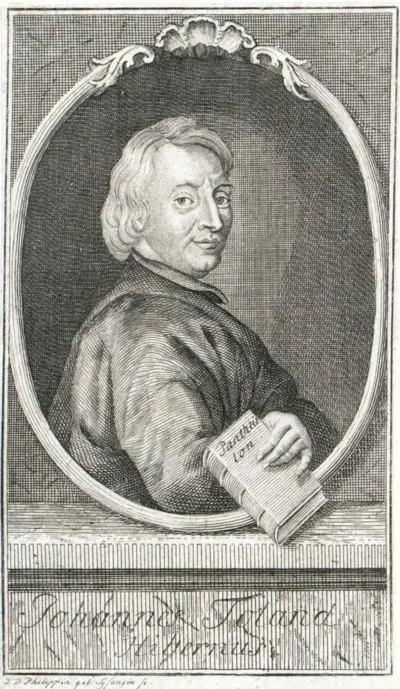
John Toland was an Irish rationalist philosopher and freethinker, and occasional satirist, who wrote numerous books and pamphlets on political philosophy and philosophy of religion, which are early expressions of the philosophy of the Age of Enlightenment. Born in Ireland, he was educated at the universities of Glasgow, Edinburgh, Leiden and Oxford and was influenced by the philosophy of John Locke.
