Abu Abdullah Muhammad Ibn Battuta Quotes
The people of Shirza are distinguished by piety, sound religion, and purity of manners, especially the women. These wear boots, and when out of doors are swathed in mantles and head-veils, so that no part of them is to be seen …. One of their strange customs is that they meet in the principal mosque every Monday, Thursday and Friday... sometimes one or two thousand of them... I have never seen in any land an assembly of women in such numbers
The large communal worship of Muslim men is dramatic throughout the Islamic world for the non-participation of women. However, as this quotation demonstrates, it was not always thus. There is precedent for large communal Islamic worship of women.
Abu Abdullah Muhammad Ibn Battuta, 1304-1377), Moroccan Berber Traveler & Explorer, Description of Women in Shiraz, a major city of Iran, Rihla [Travels]
Sourced by: Eigen's Political and Historical Quotations

This is the famous sura that has been interpreted to require women to be covered, wear the chador or burka completely covering them or just a headscarf as other Muslims interpret it. Note that a literal reading does not require complete covering. Fundamentalists in Islam do not only rely on the precise literal statement through they would never dispute it. But many would believe that it is metaphorical for not revealing anything that might be stimulating to men. The sura goes on to list those male relatives who are exempted. These are the same as those where marriage is forbidden.

This was another historical reality that shocked traditionalists. There was nothing in the Koran or Islamic scripture requiring women to wear veils and burkas. Many Muslims and non-Muslims, to this day, do not realize that.

He is often referred to as The Reformer as he was a modernist. In particular, the told his people that there was no religious obligation is Islam for wearing a veil or a burka. These are just customs. Yet most Muslims still believe that veils and burkas were required by God. The only Koranic statement on the subject simply says that women should dress modestly. Despite his efforts, veils and burkas are still required by most Afghani families and most people think the requirement is religious.

This is another quotation of Mohamed which seems positive towards women lays on them and the requirement of obedience to the husband. The obedience part is enthusiastically supported an expected by most Muslim men—even today.

He was describing the wife of the Turkish leader, Kemal Ataturk. Turkey at the time was a traditional Muslim culture where women wore burkas and very traditional Islamic female dress. Ataturk was a great reformer who placed great emphasis on reforming traditional customs of dress when supported and/or mandated by clerics. He used himself and his family as exemplars. At this particular occasion she appeared in a state ceremony wearing riding jodhpurs—pants—with leather boots and a silk blouse with no head covering. It was shocking to see an important woman in a silk blouse but absolutely astounding to see her in what was then perceived as men’s attire. Ataturk went on to completely change the nature of dress in Turkey—especially lifting the restrictions on women. See {593676}, {584524} and {610605}.


The communal support of scholarship was common in the Middle East in both Muslim and Jewish communities.

Some Muslim women in Holland are virtual prisoners of their husbands and families. Many are beaten in conformity with a fundamentalist interpretation of the Koran. Some are even killed. Under previous concepts of Dutch tolerance and respect for pluralism the Muslims in Holland were not interfered with. However, due to her efforts, the rights of the women are now taking a higher priority and are not being subjugated to tolerance of Islam generally.

The importance of women in the Hamas, fundamentalist vision is to function as a brood mare to “manufacture” men and then to bring them up which at least requires something more than their bodies. The role of women in producing other women however is never mentioned as important.
An immigrant Muslim woman herself, she was very familiar with the physical abuse of a woman in a Muslim household where she may not be the only wife and Islamic law and tradition makes her subservient to the man and allows her to be beaten by him.

This proverb is a large part of the conceptual basis of the concept of honor killing. It starts with the notion that women are property. However, being animate property women are in the same class as livestock. And if a camel or a donkey get lose and does damage, the owner is responsible. So if a woman does something wrong, it is the father or the husband who is responsible. Since sexual behavior of most kinds is contrary to the Islamic custom and law, any activity in this regard, demonstrates that the father of husband has not been up to his obligations and is therefore dishonored. Therefore, the least he can do, to provide a deterrent to other women is to kill the offending female. Without the concept of property, the entire chain of logic collapses under its own weight.
This is the type of person who suicide bomber recruiters seek out.

This prayer was made very frequently by Jewish Men for over 2000 years. Orthodox Judaism is a sexist religion and much of the sexism of the Christian churches followed this tradition. There are 3 forms of Judaism. The Reform Jews have never used this wording. Most Conservatives synagogues have changed part of the wording to read “who has made me in your image.” In a 15th century manuscript of the prayer the sexist line was rewritten as: “who has made me a woman and not a man”, so it seems there was at least one Jewish Feminist who took action.


In the last centuries, Egypt has been intellectually more advanced than the other Arab countries. It has a significant number of modernists who oppose religious influences on Government. During the Arab Spring when the old regime was ousted, the modernists had hopes that a modern democracy would be formed that was not controlled of even significantly influences by religious leaders and where women would have equal rights. However, the first election the Muslim Brotherhood, a religious party won, and then tried to institute Islamic law—Sharia. A coup ousted the Muslim Brotherhood, and then many dreamed again of a modern, non-sexist, secular democracy. Professor Ajami tried to give them a more realistic view.

This is one of the biblical passages which cause some Christian Fundamentalists to prescribe a secondary and subjugated role for women. Also the view that women, like children, should be seen and not heard. Also it supports those who object to women in the ministry or the priesthood or in senior teaching positions. See {587063}. It is useful to note that much of Islam which preaches a similar view of females, probably learned it from Christianity which preceded Islam by almost 600 years.
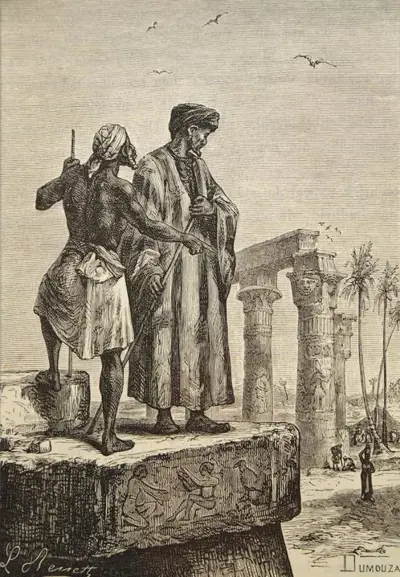
Ibn Battuta was a Muslim Berber-Moroccan scholar, jurist and explorer who widely travelled the Old World, largely in the lands of Dar al-Islam, travelling more than any other explorer in pre-modern history, totalling around 117,000 km (72,000 miles), surpassing Zheng He with about 50,000 km (30,000 miles) and Marco Polo with 24,000 km (15,000 miles). Over a period of thirty years, Ibn Battuta visited most of the Old World, including Central Asia, Southeast Asia, South Asia, China and the Iberian Peninsula. Near the end of his life, he dictated an account of his journeys, titled A Gift to Those Who Contemplate the Wonders of Cities and the Marvels of Travelling, but commonly known as The Rihla.
