Muhammad Quotes
I have been ordered to fight against people until they testify that there is no God but Allah and that Muhammad is the Messenger of Allah and until they perform the prayers and pay the Zakat, and if they do so, they will have gained protection from me for their lives and property…
Muhammad, 571-632, Prophet and Founder of Islam, An-Nawawi's Forty Hadiths
Sourced by: Eigen's Political and Historical Quotations


The Messenger is Muhammed, founder of Islam. The Hadith are his sayings which have been compiled but are not in the Koran.

In an orthodox Muslim nation, freedom of speech as a right is impossible.


This is actually a very widespread belief amongst many Muslims. Even sophisticated national leaders do not appreciate that other religions have adherents who feel just as passionately about their own religion. See {588668} for another example where Muslim leaders believe that if Jewish Kings David and Solomon came back to life they would worship Islam.

See {586039} for a quotation that goes further and seeks to punish and humiliate the non believers. This sura is often used by those wishing to illustrate the intolerance of Islam—especially of other religions. They fail to put this into the context of the Old Testament which proscribed death for heretics or the history of Christianity regarding the murder of nonbelievers. The difference is however, that a very small proportion of Jews or Christians today believe in following Biblical instructions in this respect while the proportion of Muslims who believe in the literal interpretation of scripture on these points is much larger. However there are Islamic modernists and moderates throughout the world who reject this notion of warring on all other religions and there is a struggle going on within Islam itself.

It is often said that Judaism, Christianity and Islam share the origin in Abraham. However, orthodox Muslims use this passage of the Koran to arguer that Abraham had nothing to do with Judaism or Christianity. The time line of Abraham—according to biblical time c. 4000 BC argues more for his Judaic origins, but Western religion has his sons splitting into the great faiths. Muhammed uttered these lines roughly 600 years after the birth of Christ.
This phrase has been used by fundamentalists to justify forced conversion and the imposition of religious law—Sharia—on believers and unbelievers alike. The logic is that if God says believing orthodox Mosems are the best, that is what he wants for all. And therefore by forcing others to be orthodox and of the faith, one is doing God’s bidding. See Husain Haqqani, “Islam’s Medeval Outposts,” Foreign Policy November/December, 2002.


There are many different schools of thought about Islamic Law just as there are many opnions on any legal system. However, amongst the otherox Muslims there are 5 major schools of Islamic jurispredence--4 are Sunni and 1 Shiite. These 5 all share an intolerance of other religions. The Prophet allolwed Christians, Jews and Zoroasstrians to worship in their religious manner but they had to pay a discriminatory tax. No such provision was made for other religions and some of the modern Muslims try to force them, under penalty of death, to convert to Islam. After the Iranian Revolution for example, members of the Bahai religion were mordered if they would not convert. Many were hunted down and butchered.


Damn this world, Damn this time. Damn this fate That uncivilized Arabs have come to make me a Moslem
This is a huge epic poem that he wrote over several years. At the time, the Persians considered themselves far more civilized and sophisticated than the Arabs who were but tribesmen. They really resented the fact that it was the Arabs that brought Islam. And before, most of the Persians worshipped Zoroaster. Although Islam spread faster and further than any religion in history, it was not always easily accepted as this stanza of the poem indicates. There is to this day a superiority that the Iranians perceive over the Arabs. And to this day, many Arabs resent the Iranians for this attitude.
In the early stages of Islam, Muhammad had hoped to convert the Jews and others on the Arabian Peninsula. When they refused to be converted, he warred against them usually killing the men, and taking the women and children as slaves. The result was that non-believing tribes were “cleansed” from the Arabian Peninsula. The Muslims at the time preferred children as slaves. For then they could convert the children against their will. Adults in Islam must accept Islam in order to convert. Children are regarded as having no such maturity of decision making and therefore opposition to conversion may be ignored and they may be forced. Critics of Islam and those who argue that Islam is at odds with all other religions point to this quotation. They claim that it is the only religion whose founder and fundamental scriptures demand war against others for no other reason than that they believe in a different religion. The Catholic Church during the Crusades and the Inquisition had a similar philosophy as did Christian missionaries colonizing Africa later. One difference is that most Christians today repudiate the doctrine as against the true spirit and teachings of Christ and view it as historical error, while very few modern Muslims repudiate this quotation of the Prophet.

This is another of De Tocqueville’s prescient statements that in retrospect seem so amazing given the time. This quotation could serve as an op ed in a newspaper of any of the industrial democracies of the early 21st century. However, he did not have the information of the details we have today that showed Islam as the pinnacle of scientific, philosophical, literary and medical achievement at the beginning of the second millennium, while the Christian nations of Europe were mired in the Dark Ages. It was the same Koran but a very different interpretation and framework that led to the decadence while it was the Protestant Reformation that triggered a Christianity that was hospitable to modernity and enlightenment.
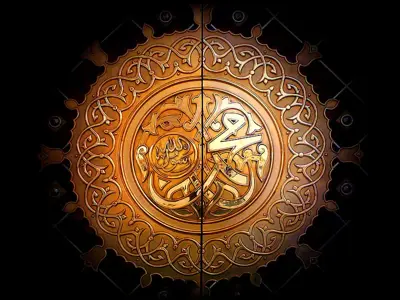
Muhammad was an Arab religious, social, and political leader and the founder of Islam. According to Islamic doctrine, he was a prophet, sent to preach and confirm the monotheistic teachings of Adam, Abraham, Moses, Jesus, and other prophets. He is believed to be the final prophet of God in all the main branches of Islam, though some modern denominations diverge from this belief. Muhammad united Arabia into a single Muslim polity, with the Quran as well as his teachings and practices forming the basis of Islamic religious belief.
