Mustafa Kemal Ataturk Quotes
[Turkish women] had lived free of the veil for 5,000 years, and had been covered only in the last 600 years.
This was another historical reality that shocked traditionalists. There was nothing in the Koran or Islamic scripture requiring women to wear veils and burkas. Many Muslims and non-Muslims, to this day, do not realize that.
Kemal Ataturk, 1881-1938, 1st President and founder of the Turkish Republic, Quoted in M. Sükrü Hanioglu, Ataturk : An Intellectual Biography
Sourced by: Eigen's Political and Historical Quotations

This statement is referring to the custom of women covering their eyes whenever a man who they did not know passed them. Turks did not ever use Burkas the way some other Muslim countries do, but they wore headscarves and covered their eyes when a strange man appeared. This was a shocking statement in a sexist Islamic culture. Although the process of modernization and reform in Turkey was relatively bloodless, Ataturk was prepared to and did use force to defend it. This and many others made the role of women not only uniquely equal in the Islamic world, but women were suddenly elevated to the level of most Western nations and in voting rights were ahead of most. He used his own family to set an example. See {584503}.

He is often referred to as The Reformer as he was a modernist. In particular, the told his people that there was no religious obligation is Islam for wearing a veil or a burka. These are just customs. Yet most Muslims still believe that veils and burkas were required by God. The only Koranic statement on the subject simply says that women should dress modestly. Despite his efforts, veils and burkas are still required by most Afghani families and most people think the requirement is religious.


The burqa wearing practice was outlawed by French Law.
al-Mansur Abu Ali. The Caliph was trying to return to Muslim Fundamentalism.
Much as a result of her efforts, New Zealand became the first country in the world to allow women to vote.

In the last centuries, Egypt has been intellectually more advanced than the other Arab countries. It has a significant number of modernists who oppose religious influences on Government. During the Arab Spring when the old regime was ousted, the modernists had hopes that a modern democracy would be formed that was not controlled of even significantly influences by religious leaders and where women would have equal rights. However, the first election the Muslim Brotherhood, a religious party won, and then tried to institute Islamic law—Sharia. A coup ousted the Muslim Brotherhood, and then many dreamed again of a modern, non-sexist, secular democracy. Professor Ajami tried to give them a more realistic view.


Most modern feminists would not agree with this quotation by one of the great early femonists.

Ingersoll was considered to be the greatest orator and political thinker of his day, but his overt atheistic views curtailed his elected political career.


Some Muslim women in Holland are virtual prisoners of their husbands and families. Many are beaten in conformity with a fundamentalist interpretation of the Koran. Some are even killed. Under previous concepts of Dutch tolerance and respect for pluralism the Muslims in Holland were not interfered with. However, due to her efforts, the rights of the women are now taking a higher priority and are not being subjugated to tolerance of Islam generally.
Islam is no more monolithic than any of the other major religions. This view is not held by most Muslim Coutnries or Islamic leaders throughout the world. It is held by a significant minority however.


This is one of the biblical passages which cause some Christian Fundamentalists to prescribe a secondary and subjugated role for women. Also the view that women, like children, should be seen and not heard. Also it supports those who object to women in the ministry or the priesthood or in senior teaching positions. See {587063}. It is useful to note that much of Islam which preaches a similar view of females, probably learned it from Christianity which preceded Islam by almost 600 years.


Anna Moiseyeva Rosenstein. See {637759} for a similar view from Austria.

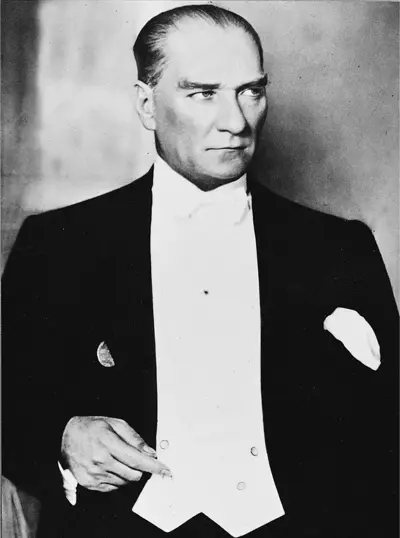
Kemal Atatürk was a Turkish field marshal, revolutionary statesman, author, and the founding father of the Republic of Turkey, serving as its first president from 1923 until his death in 1938. He undertook sweeping progressive reforms, which modernized Turkey into a secular, industrial nation. Ideologically a secularist and nationalist, his policies and theories became known as Kemalism. Due to his military and political accomplishments, Atatürk is regarded as one of the most important political leaders of the 20th century.
