Ayaan Hirsi Ali Quotes
Freeing women and giving them a chance at life is not imposing Dutch values on foreigners.
Some Muslim women in Holland are virtual prisoners of their husbands and families. Many are beaten in conformity with a fundamentalist interpretation of the Koran. Some are even killed. Under previous concepts of Dutch tolerance and respect for pluralism the Muslims in Holland were not interfered with. However, due to her efforts, the rights of the women are now taking a higher priority and are not being subjugated to tolerance of Islam generally.
Ayaan Hirsi Ali, Member of the Dutch Parliament, Quoted on CBS 60 Minutes, July 10, 2005
Sourced by: Eigen's Political and Historical Quotations


This statement is referring to the custom of women covering their eyes whenever a man who they did not know passed them. Turks did not ever use Burkas the way some other Muslim countries do, but they wore headscarves and covered their eyes when a strange man appeared. This was a shocking statement in a sexist Islamic culture. Although the process of modernization and reform in Turkey was relatively bloodless, Ataturk was prepared to and did use force to defend it. This and many others made the role of women not only uniquely equal in the Islamic world, but women were suddenly elevated to the level of most Western nations and in voting rights were ahead of most. He used his own family to set an example. See {584503}.


A Mormon Periodical. Over 5,000 women attended the meeting to protest against the condemnation of polygamy that was then ongoing throughout the country.

This was another historical reality that shocked traditionalists. There was nothing in the Koran or Islamic scripture requiring women to wear veils and burkas. Many Muslims and non-Muslims, to this day, do not realize that.

At the time most of the terrorists of the world were Muslim fundamentalists whose “values” they were supposedly fighting for included the suppression and repression of women.

This was a very unusual statement for a major party, established, politician to make in a Muslim Arab nation where sexism is not only culturally entrenched, but strongly religiously enforced.]


One of the interesting similarities between Islam and Judaism is that there is no intermediary between a person and God. There is no hierarchy of validity of interpretation other than what culturally people tend to want to respect clerics. Different cultural subgroups respect different clerical leaders and in many cases, no leaders at all. The latter is the majority in Judaism but still the minority among Muslims, The Baroness is one of the Islamic Reformers who gives little or no credence or respect to intermediaries especially males.


An immigrant Muslim woman herself, she was very familiar with the physical abuse of a woman in a Muslim household where she may not be the only wife and Islamic law and tradition makes her subservient to the man and allows her to be beaten by him.


Jinnah was a modern Islamic reformer as this quotation demonstrates. Pakistan is not as backward as most of the Arab Islamic countries on the role of women. There are many Pakistani businesswomen and professionals. Pakistan has even had a female president. However, the fundamentalist Islamic forces that dominate the culture constantly preach and advocate the literal interpretation and following of Sharia which calls for a traditional, subservient traditional role for women; “honor killings” are common; “a rapist cannot be convicted on a female victims testimony; there are calls for the killing of adulteresses and other primitive throwbacks. Jinnah’s vision has not come to pass yet.


This question he asked of an interviewee was at the time not even considered offensive of patronizing and women and men who advocated careers for women would try to explain that women could do both. Very few would counter with the point that what about men and their “neglect” of family life or the reality that through the entire Second World War MILLIONS of women were working. This quotation illustrated the culture change in the years since then.

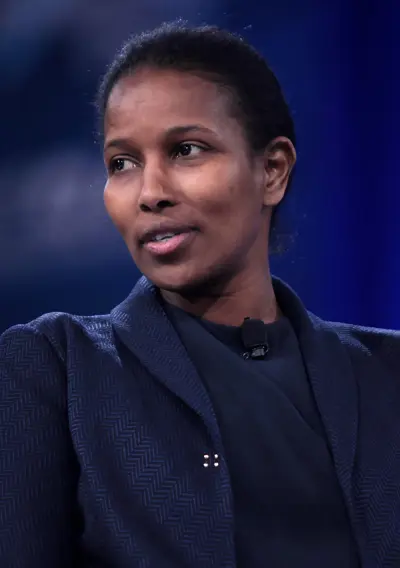
Ayaan Hirsi Ali is a Somali-born Dutch-American activist, feminist, author, scholar and former politician. She received international attention as a critic of Islam and advocate for the rights and self-determination of Muslim women, actively opposing forced marriage, honor violence, child marriage and female genital mutilation. She has founded an organisation for the defense of women's rights, the AHA Foundation. Ayaan Hirsi Ali works for the Hoover Institution and the American Enterprise Institute.
