Rutherford B. Hayes Quotes
The failure of the South to faithfully observe the Fifteenth Amendment is the cause of the failure of all efforts towards complete pacification. It is on this hook that the bloody shirt now hangs.
Rutherford B. Hayes, 1822-1893, 19th President of the United States (Republican, OH), Diary, July 21, 1880
Sourced by: Eigen's Political and Historical Quotations


Professor Egerton documents how successful Reconstruction was in radically changing the positions of Blacks in the South. He points out that it was so effective that a hate-filled, racist group of Southern White terrorists, with murder, arson, torture and intimidation took over many of the governments of the South while President Andrew Johnson, who although he believed in the Union, was himself an inveterate racist and opponent of emancipation, would not use the force of the Federal Government to bring the terrorists to justice. (The KKK leaders were known in every state and county). They successfully overthrew Reconstruction and set the process back by 100 years.


In the South racism was so extensive that Blacks were not allowed to even vote. Brooke had moved from the South to Massachusetts and there as in the North, Midwest and West, African Americans could vote. So the first time Brooke ever voted he was a candidate.


The were debating the wisdom of an Constitutional amendment to enfranchise Negroes.

Booker T. Washington was a Black leader who did much for his people, but his objectives were quite limited. He was “the white’s favorite Black man.” Du Bois not only took on the White establishment but the Black establishment as well.

Wilson, a history and government professor and college president before politics, was has been accused of being one of the most racist Presidents since Reconstruction. Prior to his Presidency, the Federal Government had been making steady progress in hiring African Americans. Under Wilson there was a wholesale firing of a large proportion of them. Some apologists argue that his League of Nations and other major aspirations required the votes and cooperation of Southern Senators who insisted that many of the blacks be terminated. At the same time, the KKK was near the zenith of its membership and political power and was an intimidating force. Wilson’s home state of New Jersey not only had a large KKK membership but there were lynching of Blacks in his own state and when Governor and President he never asked for any anti-lynching legislation.


Reconstruction was the period in the South after the Civil War. The change that emancipation brought to the white South was traumatic, and there was a constant struggle between those who wanted the Blacks to be integrated into Southern Society—and those Southerners who wanted to create a society that would be as close to slavery as possible, So the Klu Klux Klan and other terrorist organizations formed and with lynching and other intimidation, much of the initial progress of Reconstruction was rolled back and did not get reinstated until the Civil Rights and Voting Rights Acts were passed in 1964.

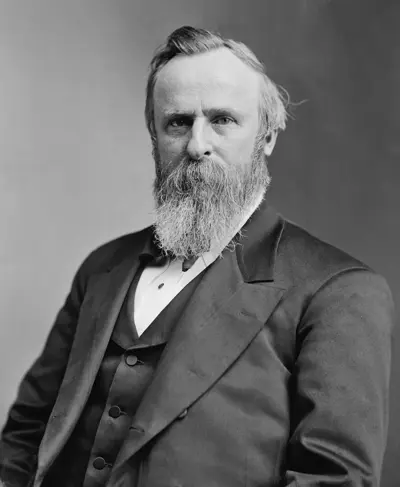
Rutherford Birchard Hayes was an American politician and attorney who served as the 19th president of the United States from 1877 to 1881, after serving in the U.S. House of Representatives and as governor of Ohio. A lawyer and staunch abolitionist, he had defended refugee slaves in court proceedings during the antebellum years. He negotiated the political agreement to end federal support of Reconstruction.
