Francis G. Caffey Quotes
The marked decrease in the average vote for congressmen in the South, from 1892 to 1902, is due primarily to the limitations upon the suffrage, and that these limitations were intended to eliminate the negro vote.
Francis G. Caffey, 1868-1951, Federal Judge, “Suffrage limitations at the South,” Political Science Quarterly, March, 1905
Sourced by: Eigen's Political and Historical Quotations

In the South racism was so extensive that Blacks were not allowed to even vote. Brooke had moved from the South to Massachusetts and there as in the North, Midwest and West, African Americans could vote. So the first time Brooke ever voted he was a candidate.


Preclearance was a requirement that any change in the voting or registration laws, rules or procedures needed to be approved by the Federal Justice Department. He was testifying about why preclearance was important and why it was placed in the Voting Rights Act every time it was reauthorized. See {635271} for what happens without preclearance.


This was art of the Nixon "Southern Strategy" to alienate the white supremacists and racists from the Democratic Party with Civil Rights legislation and rhetoric, and get most of them to become Republicans. But as Phillips observed, when Negroes began voting in significant numbers in the South the party switching really accelerated.


The President was asking for passage of his Voting Rights Bill.

At that time a number of state legislatures all changed their state voting laws to require citizens who try to register to vote to have documentation of various kinds and or obtain special documentation. These were generally possessed by upper class and educated people but not in as large proportions by lower and working class people. To obtain the documents and register if things like original birth certificates were not possessed, the citizen had to lose much of a day’s work and travel some distance. The burden existed on most lower class people and especially the minorities. The courts nullified some of these discriminatory requirements for voter registration, but many were allowed. The rationale was to prevent voter fraud and yet there were almost no cases of voter fraud in the entire country. While the requirements were racially discriminatory, they were also socioeconomically discriminatory. By coincidence, or perhaps not, every state that added these requirements had a Republican controlled state legislature AND a Republican Governor. Despite the effort to suppress Obama and Democratic voters, the effort backfired. Minorities and especially Blacks were so outraged that Jim Crow voting suppression had returned that they made a huge effort to register and get out the vote and Blacks voted in a much larger proportion than historical and well over 90 percent voted for Obama who won the election handily.
At the time Negroes were prohibited from voting by a series of discriminatory criteria for voter registration and intimidation so that Blacks would not generally even try to register. But the Civil Rights movement changed tactics and organized large scale attempts at voter registration. Mayor Thompson and the white power structure of the town were not going to allow that. They had not only enlarged the police department but the city purchased an a small armed tank.


The rich whites won the class war by splitting the poor and working class with race hatred and then coopting one half—the poor whites so that neither the poor whites or blacks obtained much and even into the 21st century the poor of the American South were the worst off of all the poor in America.


At the time the Democratic Politicians of the South went to extremes from refusing to register Black voters to countenancing assault, torture and even murder of Blacks who organized voter registration. When the racists switched to the Republican party, is was Republican politicians who tried to make voter registration and voting more difficult for minorities, but the means and degree of these efforts were very mild compared to what is was when Rustin uttered this quotation.

Vardaman, on of America’s worst racists, was one of the main drafters of that constitution. This is an example of why the Voting Rights Act was later needed to unravel a endemic system of keeping African Americans from voting or having any part in politics.
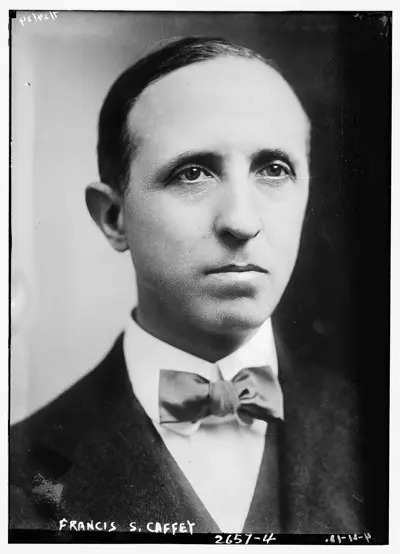
Francis Gordon Caffey was a United States District Judge of the United States District Court for the Southern District of New York.
