John Rankin Quotes
Surely this is a bad beginning in Lane Seminary. If it is to be governed by the excitements of Cincinnati, and especially … excitements so unreasonable, and if the students are to be placed under laws [so as] to appease the mob, the church will have little hope either from its purity or its influence. [When] it is found that it can be governed by city excitements it may expect to be favored with enough of them. Better far for the Seminary and the honest religion, the mob had torn the building to the ground. It could have been reared again as a standing monument of integrity.
Students at Lane Seminary organized anti-slavery protests and seminars. Cincinnati, close to the South had many pro slavery advocates, and these threatened the trustees that they would burn the school down unless the students were reigned in. They were, but it backfired when there was an investigation of the Lane Seminary from which this quotation is taken.
John Rankin, 1793-1886, Pastor of the First Presbyterian Church of Ripley, Ohio, Founder of the first anti-slavery society in Ohio, 1835, Operator of Rankin House, a key stop on the Underground Railroad, Defense of Seminary Students organizing Anti-Slavery Activities, 1935
Sourced by: Eigen's Political and Historical Quotations


Benezet was a Huguenot whose family had been persecuted in France. He identified with the cause of Blacks, Indians and Acadians. He was also one of the first leaders of the American Peace Movement.
At the time Canada was one of the preferred destinations of escaping slaves traveling the Underground Railroad.
The first anti-slavery newspaper published in the United States & the first journal in America to advocate immediate, unconditional emancipation


One of the many complaints that many people made at the time about Smith and his Mormons was that they opposed slavery. In fact, Smith not only opposed it be had a plan for compensating the slave owner and a method for paying for it. Smith was not advocating the kinds of personal lifestyle issues of his church the way modern religious leaders do, but was concerned with the much larger issues of expansionism, corruption of the courts and judiciary, and land distribution. He was a classic reform candidate in that sense. Smith had written to most of the then likely Presidential candidates of both major parties asking for their position on the Mormons who were facing persecution wherever they went. None of the politicians would make any satisfactory commitments. Smith took Direct Action and became the only major religious official to have run for the Presidency of the United States until Pat Robertson tried and failed in 2000. Smith’s assassination shortly thereafter cut his run for the Presidency short before it made much headway and politically he had no chance to affect the race.

Toynbee was very active in attempting to reform the Church of England.

Starting with the Crusades, the Popes began giving indulgences to those who would die in battle fighting for a holy cause. The Papacy was then at one of it’s lowest points. Two men, Clement and Urban, both claimed the Papacy and each had raised an army to fight the other. Each was promising indulgences to those who would fight, and in a modality similar to the Muslim terrorists of the 21st century, the soldiers were promised ascendancy to Heaven if the fell in battle for such a holy cause. Wycliffe, in a wonderfully original notion, proposed that the people who live in peace be granted the indulgences. See {618086}.


The “cause” was two-fold: abolition of slavery and establishment of women’s rights, especially suffrage. Some abolitionists and feminists thought it essential to win the support of clergymen.

It was in fact, the following year when the South rebelled to prevent a “settlement”, but the irony was that the Civil War brought the settlement—emancipation-- faster and on less favorable terms than had they not rebelled and let the political process end slavery gradually as the majority of the nation wanted and morality dictated.

The Sally was a ship that belonged to his family business that engaged in a slave trading voyage where many slaves were killed. It was a traumatic experience for Moses Brown and he became a staunch abolitionist and in this letter persuaded other Rhode Island merchants to avoid the slave trade. See {641478} and {585793}.

“Manumitting” means the freeing of slaves. See Quotation 643600 for Laurens’ view of slavery despite the fact that he was a substantial slave owner. He was willing to lose the money represented by the value of his slaves, but most slave owners self interest was to the contrary. One of the most interesting thing about this quotation is the fact that Laurens received so much opposition from his fellow South Carolinians and other Southerners despite the fact that only Laurens would lost money by freeing his slaves. Even slave owners who wanted to do the right thing and were willing to lost the money were under enormous social and political pressure not to free slaves.
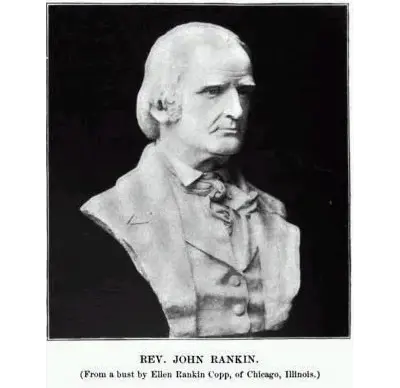
John Rankin was an American Presbyterian minister, educator and abolitionist. Upon moving to Ripley, Ohio, in 1822, he became known as one of Ohio's first and most active "conductors" on the Underground Railroad. Prominent pre-Civil War abolitionists William Lloyd Garrison, Theodore Weld, Henry Ward Beecher, and Harriet Beecher Stowe were influenced by Rankin's writings and work in the anti-slavery movement.
