JOHN BROWN
(John H. Brown)

John Brown, in a futile effort to start a slave insurrection, raided the arsenal at Harper’s Ferry. His raid failed and he was captured and hanged. However, he became a martyr to the abolitionist movement, and his death is still sung of gloriously to this day. See {584889} and {604003}.

Andrew had actually contributed money to Brown’s movement. This quotation is a wonderful illustration of the schism that existed in pre-Civil War America. Brown had just led an armed attack on a Federal Facility, been tried and executed. Imagine sympathy and justification for such an act by a leading politician in modern times.


See John Brown {595833} and {595836} for samples.

The last lines of the editorial were tragically accurate in predicting the Civil War. The more the slavery question was debated in the nation, the more polarized the country became. If the South would persist in trying to curtail men’s freedom and maintain slavery, the slaves had the same right of revolution and insurrection as was established in the American Revolution. That was the view of most abolitionists. Southern slave holders, feared an armed slave rebellion more than anything else, and observed that debating the issue of slavery was just riling up Blacks and whites and would instigate such armed revolutions. The Southern solution was to cease debating the slavery question. The Northern solution was to end slavery. Neither side would accept the solution of the other and the Civil War ensued.


It was not successful militarily and Brown and his followers were hanged, but they rapidly became martyrs to the cause of freedom and abolition. As such they inspired not only abolitionists but many of the Northern soldiers in the Civil War. There were verses to the Battle Hymn of the Republic which were often sung by the Union Troops.”


“Captain Brown” referred to the radical abolitionist, John Brown, 1800-1859, who was then about to be executed for his violent abolitionist activities in attacking the military arsenal at Harper’s Ferry and planning to arm slaves for a slave revolt. His view of revenge was to eliminate slavery. Note that he was a moral sympathizer of Brown. See {633849}.
In 1856 Kansas was at war over slavery. Kansas was to enter the Union with the resident men voting to determine whether it would be a slavery state or a free state. At first pro-slavery forces sent men into Kansas to increase the pre-slavery vote. The abolitionist anti-slavery forces outside of Kansas did the same, and had more money to finance anti-slavery settlers. Soon the pro-slavery forces, realizing that they would be outnumbered turned to violence and began to intimidate abolitionist settlers to return from whence they came. Soon abolitionists were killed and the anti-slavery men retaliated. Soon real war broke out but terrorism was the modality on most attacks as the purpose of the pro-slavery men was to frighten the abolitionists—many of whom were religious pacifists—into leaving the state. Brown and some other abolitionists retaliated with terror of their own, but Brown was rabid. He and his sons, attacked 5 pro-slavery fighters at Pottawatomie Creek, but Brown personally hacked off their limbs with a broadsword and left the bodies to intimidate and terrorize many of the pro slavery people. Brown was such a fanatic that he, in this infamous quote, claimed that his killing and butchery was “justified under the circumstances.” The phrase “Bleeding Kansas” came from the violence and terrorism in this period.
He was also himself a ship owner in the slave trade and he was the brother of the leading Rhode Island abolitionist, Moses Brown. See {585793}. Brown became the first American, prosecuted in federal court for illegal slave trading –-- a prosecution brought, in part, by his own brother. He was, however, acquitted.
Brown wanted Douglass to join his band of 22 men for the raid on Harper's Ferry. Douglass not only refused to join but tried to dissuade Brown from carrying out the raid.
The Brown family were very wealthy. John was involved in many speculative enterprises, owned slaves, and had been in the slave trade, and then it had been outlawed in large part by the efforts of his brother, Moses Brown who was a staunch abolitionist and an officer of the Rhode Island Abolition Society. The quotation is important because one theory is that the only reason that the slave trade became illegal was because it was not very profitable due to the high cost and loss ratio and the competition from slaves who were born of slave mothers. So the slave trade was outlawed but not slavery which was so profitable. However, this quotation illustrates how profitable the slave trade was and the early legislation was therefore motivated by ethical and moral concerns.
He was also himself a ship owner in the slave trade and he was the brother of the leading Rhode Island abolitionist, Moses Brown. See {585793}. Brown became the first American, prosecuted in federal court for illegal slave trading –-- a prosecution brought, in part, by his own brother. He was, however, acquitted.
His prediction would come true 72 years later. He was a slave trader and a strong supporter of the institution. See {624060}. However unlike most slave supporting Southerners, he came from one of the richest families of New England. His own brother Moses Brown was an ardent abolitionist and John was able to see the arguments and forces lined up against slavery. He saw that abolitionists as the trouble makers because they were trying to change the status quo. Having much experience with Southerners and selling them many slaves, he realized early how the South was totally dependent on slavery for its economic and social way of life. Few Americans had that broad a perspective.
Indeed he was. Relatively unknown before his execution, he became one of the most recognized martyrs and characters of history. Songs about him are even today sung by people who have no idea who he was or what he stood for, but in his death he drew attention to the evils of slavery as few others had.
Douglass tried to talk Brown out of what Douglass thought would be a suicide raid. Douglass was right.
They had seen many other abolitionists attacked and butchered by the pro-slavery forces. The civil war of Kansas was over whether Kansas would enter the Union as a slave state of a free state. If a free state, the free states would be able to block further slavery. If Kansas were to become a slave state, the slave states would have a sufficient majority to make all future expansion hospitable to slavery. The slavery forces started sending man and families into Kansas so that they could vote; the abolitionists did the same. Both sides armed and a war began with each faction trying to kill or drive the other faction out of Kansas before the vote. See {617388} and {612516}.
Brown was then a member of the state legislature representing Providence. He was also himself a ship owner in the slave trade and he was the brother of the leading Rhode Island abolitionist, Moses Brown. See {585793}. John Brown became the first American, prosecuted in federal court for illegal slave trading –-- a prosecution brought, in part, by his own brother, Moses. He was acquitted.
The cotton industry and slavery were a very important part of the economy of Providence, RI. The Rhode Island cotton mills were supplied by Southern cotton produced by slaves and carried from the South on Rhode Island ships. Many of the southern slaves were kidnapped from Africa from Rhode Island slave trading ships. When the slave trade was made illegal, Brown was the first slave trader prosecuted. His brother, Moses Brown, a vehement abolitionist was one of the men who brought the prosecution.
Brown was the richest man in Rhode Island and made much of his money in the slave trade. This quotation shows that slavery was not completely a North verses South split. Northerners like Brown for whose family Brown University was named, was as virulent supporter of slavery as the most ardent Southerner.
In 1856 Kansas was at war over slavery. Kansas was to enter the Union with the resident men voting to determine whether it would be a slavery state or a free state. At first pro-slavery forces sent men into Kansas to increase the pre-slavery vote. The abolitionist anti-slavery forces outside of Kansas did the same, and had more money to finance anti-slavery settlers. Soon the pro-slavery forces, realizing that they would be outnumbered turned to violence and began to intimidate abolitionist settlers to return from whence they came. Soon abolitionists were killed and the anti-slavery men retaliated. Soon real war broke out but terrorism was the modality on most attacks as the purpose of the pro-slavery men was to frighten the abolitionists—many of whom were religious pacifists—into leaving the state. Brown and some other abolitionists retaliated with terror of their own, but Brown was rabid. He and his sons, attacked 5 pro-slavery fighters at Pottawatomie Creek, but Brown personally hacked off their limbs with a broadsword and left the bodies to intimidate and terrorize many of the pro slavery people. Brown was such a fanatic that he, in this infamous quote, claimed that his killing and butchery was “justified under the circumstances.” The phrase “Bleeding Kansas” came from the violence and terrorism in this period.
Brown was executed for trying to steal federal arms and start a slave rebellion. However, to many Americans, his moral judgment was correct. He became a martyr for many abolitionists, and some Northern Civil War songs extolled him and saw his as an early forerunner of a great moral struggle. See Thoreau {633849} as an example. There were many other Americans who were abolitionists and did not approve of either of the method his violent raid or its purpose of arming the slaves as they feared a bloodbath of vengeance.
It was in fact, the following year when the South rebelled to prevent a “settlement”, but the irony was that the Civil War brought the settlement—emancipation-- faster and on less favorable terms than had they not rebelled and let the political process end slavery gradually as the majority of the nation wanted and morality dictated.
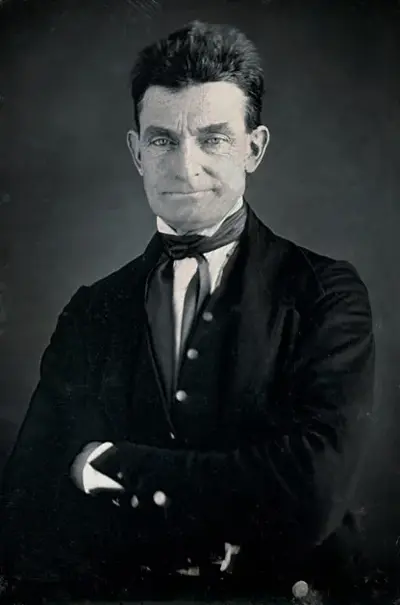
- Born: May 9, 1800
- Died: December 2, 1859
- Nationality:
- Profession: Tanner; Cattle, Horse, Sheep Breeder Trader; Farmer
John H. Brown was an American abolitionist leader. Brown felt that violence was necessary to end American slavery, as years of speeches, sermons, petitions, and moral persuasion had failed.
