Henry David Thoreau Quotes
I foresee the time when ... at least the present form of Slavery shall be no more here. We shall then be at liberty to weep for Captain Brown. Then, and not till then, we will take our revenge.
“Captain Brown” referred to the radical abolitionist, John Brown, 1800-1859, who was then about to be executed for his violent abolitionist activities in attacking the military arsenal at Harper’s Ferry and planning to arm slaves for a slave revolt. His view of revenge was to eliminate slavery. Note that he was a moral sympathizer of Brown. See {633849}.
Henry David Thoreau, 1817-1862, Writer, “A Plea for Captain Brown,” October 30, 1859
Sourced by: Eigen's Political and Historical Quotations

Brown was executed for trying to steal federal arms and start a slave rebellion. However, to many Americans, his moral judgment was correct. He became a martyr for many abolitionists, and some Northern Civil War songs extolled him and saw his as an early forerunner of a great moral struggle. See Thoreau {633849} as an example. There were many other Americans who were abolitionists and did not approve of either of the method his violent raid or its purpose of arming the slaves as they feared a bloodbath of vengeance.

Simon Bolivar and other freedom fighters in South America used this quotation to justify numerous acts of retaliation against the Spanish troops controlling their countries.


Actually under Islamic law teh relatives of the victems can grant mercy, and they are frequently paid money by the family and friends of the accused murderer to do so. in many cases, the wealthy offender can avoid even long jail terms. However, if the victim's family is also very wealthy, they would often exact vengeance and have the killer executed. This is one major difference between must Western law and Islamic law. In the West we do not giver the relatives of the victim any significant role in the process. Vengeance is not recogniszed and it is society that acts. Recently some states have allowed victim families to man imact statment s to the jury or judge. There had been an aborted revolution and several hundred Turks were killed in the battles betwen the revolutionists and the police and non-revolutionary soldiers.


His family was one of the wealthiest in Rhode Island. He called in the entire family and he formally read the deed. The family itself had actually been active in the slave trade under John, his oldest brother, so this deed was very shocking to them. Moses became a leading abolitionist in Rhode Island and John the major defender of slavery in the state. Despite that, the brothers actually remained close.

Lincoln later changed his mind about Colonization when some Black leaders pointed out that the Blacks had built a large part of America and also survived slavery, it they were given fair opportunity, there was no reason that they would not be able to compete and thrive.


Andrew had actually contributed money to Brown’s movement. This quotation is a wonderful illustration of the schism that existed in pre-Civil War America. Brown had just led an armed attack on a Federal Facility, been tried and executed. Imagine sympathy and justification for such an act by a leading politician in modern times.


It is not known what actually happened thereafter. However, from the intensity of this letter, it is likely that unless Rice was killed or wounded in battle, he went to get his daughter and deal with her “owner”. An interesting side note is that the slave owner actually sent the letter to the Commanding Union General Rosecrans complaining. The mental set of Southern Slave Owners was incredible to us today, but that is one of the reasons that Reconstruction was so difficult. Southerners could not see anything that they did that was wrong. Unfortunately, there are a few racist people with those views still in America plus many throughout the world.

Nathaniel Bacon had led a rebellion in Virginia and had routed the Governor’s troops and caused him to flee leaving control of Virginia to Bacon and his followers who were far more democratic and advanced. However Bacon succumbed to swamp fever, and his followers could not hold the colony together giving the Governor a chance to establish his authority. He then went on a vengeful reign of terror, executing all of Bacon’s followers he could get his hands on. With no danger to the authority of the Crown, King Charles felt that Berkeley had gone too far. The King’s father Charles I had been executed in the aftermath of the English Civil War, but he had executed far fewer than Berkely had done in Virginia.


Even before we had a Constitution there was major opposition to slavery. The “price” of the American Union was the acceptance of the slavery of the South. But the hypocrisy of a country based on liberty to allow and enforce slavery was not lost on the founding fathers. Ironically the abolitionists among the founding fathers were certain that they could persuade the Southern slaveholders of the error of slavery in a few years and things would be set right in the land. Even George Washington {630626}, and Thomas Jefferson and some other slaveowners at the time wished to see its abolition. Slaveholding Southern Founding Fathers in general were so wary of the abolitionists that they achieved structural, disproportionate, power in the new Constitution to ward off the abolitionists attempts to reform slavery.


When the Confederate Government realized that the Union was planning to arm escaped slaves and induct them into the Union Army, they quickly passed a law that declared any escaped slave who joined the Union Army or wore its uniform was guilty of Treason and would be executed. Most Union Generals one way or another got word to the Confederate Officers that they had better treat all Negro Union Soldiers as prisoners of war. Even President Lincoln warned the South. Butler, however, had a large number of Negro troops in his area and had heard threats of some of the Southerners to execute Black prisoners of war. He had a way of making things very clear, and he was able to prevent murder of any of his Negro troops despite the Treason law.


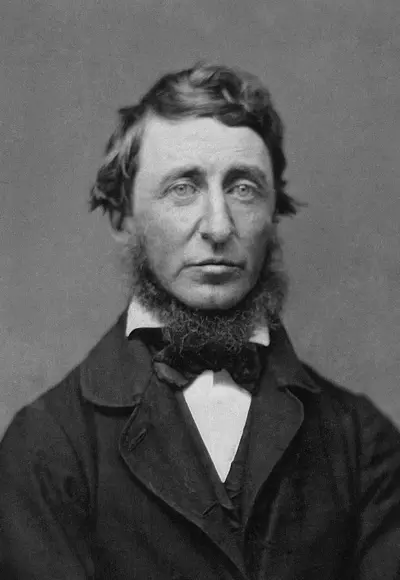
- Born: July 12, 1817
- Died: May 6, 1862
- Nationality: American
- Profession: Author
Henry David Thoreau was an American naturalist, essayist, poet, and philosopher. A leading transcendentalist, he is best known for his book Walden, a reflection upon simple living in natural surroundings, and his essay "Civil Disobedience" (originally published as "Resistance to Civil Government"), an argument for disobedience to an unjust state.
