John Brown Quotes
Trafficking Negroes is right, just and lawful. In my opinion there is no more crime in bringing off a cargo of slaves than in bringing off a cargo of jackasses.
He was also himself a ship owner in the slave trade and he was the brother of the leading Rhode Island abolitionist, Moses Brown. See {585793}. Brown became the first American, prosecuted in federal court for illegal slave trading –-- a prosecution brought, in part, by his own brother. He was, however, acquitted.
John Brown, 1736–1803), U. S. Congressman (Federalist, RI), Member of the Continental Congress, Merchant & Shipping Magnate & Slave Trader, Argument and debate with his brother in defense of the slave trade
Sourced by: Eigen's Political and Historical Quotations

His family was one of the wealthiest in Rhode Island. He called in the entire family and he formally read the deed. The family itself had actually been active in the slave trade under John, his oldest brother, so this deed was very shocking to them. Moses became a leading abolitionist in Rhode Island and John the major defender of slavery in the state. Despite that, the brothers actually remained close.


Jefferson had calculated that if he allowed slaves to “breed”, he could realize a profit of 4% a year just from the increase of the number of slaves he owned. He recommended the business of breeding slaves to several people, and at this time showed no moral compunction about slavery.


Louisiana to this day has a different legal system from the rest of the United States as it was originally based on the French Napoleonic Code. Most people did not realize that Louisiana had strictures against breaking up families—even with slaves.
The white skilled laborers of the North were not the only ones who found slavery deleterious to their economic well being. The complaints to the Carolina legislature produced a finding as early as 1744 that whites were adversely affected.

See the Vermont Constitution for another variant of how slavery was abolished: {616994}


The perception of the necessity of slavery was evident very early in the South.


In the Jim Crow era and well into the 20th century, many school books and historians, wanting to minimize the enmity between North and South, tended to a historical revisionism where the real brutal and immoral edge of slavery was minimized and slave owners were depicted as being in error by modern standards but well-meaning and paternalistic. Foner, with this famous quotation, put the lie to the false image of paternalistic slavery. By the beginning of the 21st century, there were very few serious historians who still tried to characterize slavery in the South as “paternalistic” otherwise humane. See {584014} for another of Foner’s famous quotes regarding slavery
[This was the first Abolition appeal written by a Black Man. It was published in Boston and was very popular going through two more printings within the next two years.]


For a slave to run away, capital punishment was not only authorized, but ANY white could execute the runaway, without even a trial. Needless to say that many slaves who were not runaways were killed.


Miller was the first Black American admitted to a Graduate Program—Johns Hopkins—in Mathematics
The phrase “give him a call” is interesting before the telephone. The ad gave a general area where he hunted and might be found. Potential customers were to go to that general area and “give him a call” vocally.
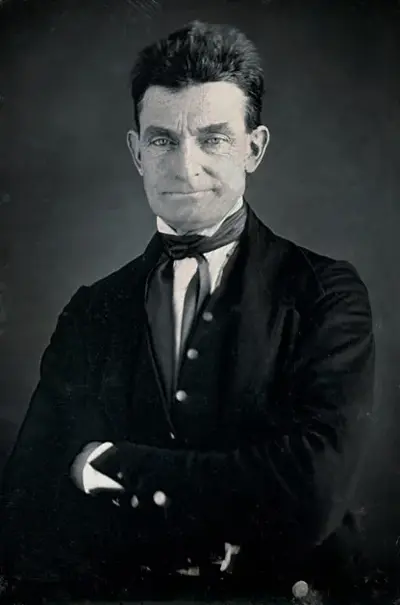
- Born: May 9, 1800
- Died: December 2, 1859
- Nationality:
- Profession: Tanner; Cattle, Horse, Sheep Breeder Trader; Farmer
John H. Brown was an American abolitionist leader. Brown felt that violence was necessary to end American slavery, as years of speeches, sermons, petitions, and moral persuasion had failed.
