Henry Laurens Quotes
Not less than twenty thousand pounds sterling would all my Negroes produce if sold at public auction to-morrow. I am not the man who enslaved them; they are indebted to Englishmen for that favor; nevertheless I am devising means for manumitting many of them, and for cutting off the entail of slavery. Great powers oppose me--the laws and customs of my country, my own and the avarice of my countrymen. What will my children say if I deprive them of so much estate? These are difficulties, but not insuperable. I will do as much as I can in my time, and leave the rest to a better hand
“Manumitting” means the freeing of slaves. See Quotation 643600 for Laurens’ view of slavery despite the fact that he was a substantial slave owner. He was willing to lose the money represented by the value of his slaves, but most slave owners self interest was to the contrary. One of the most interesting thing about this quotation is the fact that Laurens received so much opposition from his fellow South Carolinians and other Southerners despite the fact that only Laurens would lost money by freeing his slaves. Even slave owners who wanted to do the right thing and were willing to lost the money were under enormous social and political pressure not to free slaves.
Laurens, Henry. "Letter to John Laurens, 14 August 1776." The Papers of Henry Laurens, Volume 11: Jan. 5, 1776 - Nov. 1, 1777, edited by David R. Chesnutt, University of South Carolina Press, 1988, pp. 224-225.

Our Founding Fathers were divided into three general views about slavery. There were abolitionists for whom slavery was abominable and should be eliminated—these were mostly in the Northern States but with a few Southerners. Then there was the opposite view held by most Southerners, that slavery was not only a natural and moral institution but it was an economic and social necessity. Last were those like Laurens, George Washington and Thomas Jefferson. Slave owners who grew up with slavery as a norm but came to see its evils and the complexity of change and reform in that area.

The Confederates had a strategy of obtaining material assistance, prestige and recognition from England during the civil war. Confederate diplomats reported favorable attitudes of English diplomats. However, Southern leaders were in absolute denial about and insensitive to the revulsion that most of Europe and the sophisticated nations felt about slavery at the time." 1st Viscount Lyons

In early New England the General Court served as both a legislature and a judiciary before separation of powers was introduced. 5 years later the Court banned importing African slaves at all. While slavery was not common in Rhode Island, the laws was not seriously enforced on those who would defy them. It does represent a public anti-slavery sentiment that existed in Early America. It would take 200 years for Rhode Island to finally eliminate all forms of slavery.


The first anti-slavery newspaper published in the United States & the first journal in America to advocate immediate, unconditional emancipation

The bill was defeated in the Confederate Senate {590064} so was the last good opportunity for the Confederacy. Lee was totally correct about what the Union would do, and the Northern use of Negro troops from the South was the final nail in the Confederate coffin.

As an entertainer she had toured much of the world and seen American slavery and that of some other nations. She became a staunch abolitionist and like entertainers in the 20th and 21st centuries she used her celebrity to give anti-slavery lectures and perform for audiences where she donated the proceeds of the event to the abolition cause. She is a particularly interesting political figure in that she seems to be one of the first entertainers to perform for a social cause and become an activist.
Many English slaves had been brought into Ireland by kidnappers and purchasers of English children as described in the quotation by Girald of Wales. The Irish kept them in bondage. In 1171 English invasions of Ireland appeared to be succeeding and the Irish clerics decided that they were being punished by God for the slavery. The edict was issued with the force of law. For insight into the common practice of kidnapping slaves in England, see Council of Westminster.


Benezet was a Huguenot whose family had been persecuted in France. He identified with the cause of Blacks, Indians and Acadians. He was also one of the first leaders of the American Peace Movement.

While England was strongly opposed to slavery, the English textile industry benefited from importing American Southern cotton. So many in England were supportive of the Confederacy.


The Emancipation Proclamation was issued by the commander in chief as a wartime necessity. Any future President could undo that proclamation. However, the 13th Amendment outlawed slavery forever regardless of the desires of the Congress, Presidents, or State governments.

The cause of the Civil War was slavery. When the Souh fired on the nation’s army and governmental personal, the secession became treason. So Slavery was the cause of the treason. Douglass argued that if we eliminate slavery, we eliminate the cause of the Treason.

Majority public opinion does not always prevail in a modern democracy as there are Constitutional limits on the prerogatives of the majority. Also leadership has played a strong role in America’s development where strong leaders have been able to do the right thing despite contrary public opinion.
A few years later he had a clearer idea of what was to be done. However, the additional factor of the Civil War played a big part in driving his Emancipation Proclamation. See {609360}
Jefferson was then the United States Minister to France. While in Paris he was offered membership by M. de Warville in the Society for the Abolition of the Slave-Trade. Jefferson felt that he had to decline because his joining would have been seen as a politically polarizing act, inappropriate for an Ambassador of the American government which was divided on the issue of slavery. Some criticize the refusal and argue that this would have been the perfect act to push the abolition perspective, and question Jefferson’s sincerity about slavery as he not only refused to join the society, but never freed his own slaves though it is argued that he never made enough money to afford to emancipate them.

Pernambuco is a state of Brazil. His voyage took him to several slave countries.


Even before we had a Constitution there was major opposition to slavery. The “price” of the American Union was the acceptance of the slavery of the South. But the hypocrisy of a country based on liberty to allow and enforce slavery was not lost on the founding fathers. Ironically the abolitionists among the founding fathers were certain that they could persuade the Southern slaveholders of the error of slavery in a few years and things would be set right in the land. Even George Washington {630626}, and Thomas Jefferson and some other slaveowners at the time wished to see its abolition. Slaveholding Southern Founding Fathers in general were so wary of the abolitionists that they achieved structural, disproportionate, power in the new Constitution to ward off the abolitionists attempts to reform slavery.

For more about the Bureau. See {629185}.and {629187}.
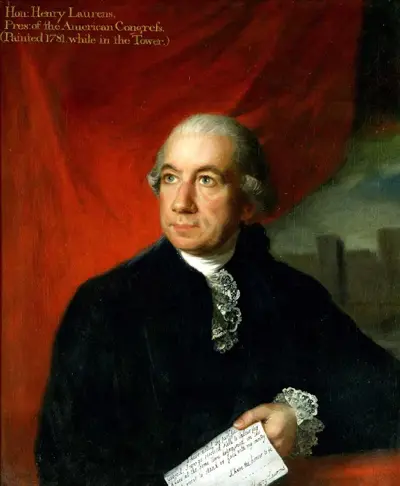
- Born: March 6, 1724
- Died: December 8, 1792
- Nationality: American
- Profession: Politician
Henry Laurens was an American merchant, slave trader, and rice planter from South Carolina who became a political leader during the Revolutionary War. A delegate to the Second Continental Congress, Laurens succeeded John Hancock as President of the Congress. He was a signatory to the Articles of Confederation and President of the Continental Congress when the Articles were passed on November 15, 1777.
