Preston Brooks Quotes
Some time since a Senator from Massachusetts allowed himself, in an elaborately prepared speech, to offer a gross insult to my State, and to a venerable friend, who is my State representative, and who was absent at the time. Not content with that, he published to the world, and circulated extensively, this uncalled for libel on my State and my blood. Whatever insults my State insults me. Her history and character have commanded my pious veneration; and in her defense I hope I shall always be prepared, humbly and modestly, to perform the duty of a son. I should have forfeited my own self-respect, and perhaps the good opinion of my countrymen, if I had failed to resent such an injury by calling the offender in question to a personal account.
In the lowest point in Senate history, Senator Brooks snuck up behind Senator Charles Sumner, stuck Sumner a massive blow to the back of the head with a heavy stick. While Sumner was half conscious and caught in his desk, Brooks continued to beat Sumner senseless. Sumner did not die but was seriously handicapped for life. Preston attacked Sumner supposedly because Sumner made a senate speech condemning slavery practices in South Carolina and “insulted” Brooks’ cousin—a Congressman who was defending slavery. Because of the polarization between North and Southern senators, no resolution could be passed to condemn and discipline Brooks so the Senate became the only place in America where someone could beat an unarmed, defenseless man senselessly with impunity. Even some Southerners were surprised because at that time “Gentlemen” still fought duels over disputes and in those, both parties would be equally armed.
Preston Brooks, 1819–1857, U. S. Congressman (Democrat, SC), Speech in The Senate, July 14, 1856
Sourced by: Eigen's Political and Historical Quotations

Congressman Preston Brooks had attacked and almost murdered, Senator Sumner, who was caught in his desk and could not defend himself. While the beating of legislators who positions that were disliked was castigated by almost all newspapers and community leaders in the North and many in the South, this editorial shows how far the polarization of American had gone before the Civil War. It also illustrated that the issue causing the schism was slavery and not as later Southern apologists suggested, different philosophies of government.


In 1856 Senator Charles Sumner, a strong slavery opponent, was writing at his Senate desk and a Southern Congressman, Preston Brooks, sneaked up behind him and beat him senseless with a heavy cane. The beating shocked most of the country and ended much of the comity between pro-slavery and anti-slavery members of Congress. Sumner was in treatment and therapy for 3 years, but returned to the Senate to be one of the radical Republican abolitionists who pressured Lincoln on the emancipation issue and led the vigorous Reconstruction efforts after the war. For the northern newspapers, this became the symbol of Southern lack of civilization and fanaticism which did as much as anything to set the stage for the Civil War. A majority of the House of Representatives voted to expel Brooks, but the necessary two-thirds could not be obtained because Southerners supported Brooks creating even more division between North and South. Brooks was so shunned however that he shortly resigned.

Adams had submitted to the House a petition from some of his constituents calling for a dissolution of the Union on the grounds that the existence of slavery nullified a sufficient part of the Constitution and the Bill of Rights so that the union should be nullified and in effect anti slavery states such as Massachusetts would not be bound by slavery supporters blocking anti-slavery legislation. State’s rights and succession cut both ways potentially in America’s race history. The vast majority of the house members were indignant that any responsible member would introduce a petition, and there were calls for Adam’s expulsion from the House from the majority of the members. The leadership however thought this might set some bad precedents, and tried to persuade the membership to on the grounds of mercy and comity just censure him. Adams responded with this famous quotation cutting the legs from under both the leadership and the membership with the result being that no action was taken.


After Adams’ term as President, he was elected to the House of Representatives where he served for the rest of his career. He was constantly calling for the emancipation of slaves (see {77463}) in the House debates. The Southern Congressmen were so offended by this that they got the majority of the House to pass a rule that made using the word “slavery” out of order. It was called the “Gag Rule”. Adams, one of the best legislators and lawyers of his day, then started reading in the House debates petitions of his constituents calling for an end to slavery. The Southerners called for the Speaker to declare him out of order for violating the gag rule. But Adams pointed out that the Constitution gave citizens the right to petition Congress with no controls on the petitions. Therefore the reading of the petitions was Constitutionally mandated and trumped the Rules of the House. He then arranged to have many petitions submitted which he dutifully read on the House floor to the extreme anger of the Southerners.

That particular Congress was the worst in American history in terms of passing legislation. Mainly there was philosophical gridlock between conservatives and liberals and worse between Tea Party Conservatives and mainstream conservatives. The Iraqi legislature was gridlocked religiously between Sunni and Shiite Muslims.

The Congressman was not even chastised by the House of Representatives.


His enemy was always the Spanish colonialists—never the people of South America.

Despite having passed the House and a majority of the Senate favoring McCain’s bill, a filibuster was led by a few holdouts from his own party. Patiently, McCain assembled sufficient Senate support to break the filibuster.

The senator had broken with his own party on the issue of slavery in the territories.


His admonition did little good. That Congress passed fewer bills than any other in history.


That 113th Congress was the most unproductive in history. It was so bad, that even the Senate Chaplain prayed for a change.


This is an important political quotation because it illustrates one of the major reasons that Congress was so gridlocked at the time and passed hardly any legislation at all. Farenthold was a relatively new Congressman supported by the Tea Party extreme conservatives. He had no Congressional legislative experience and viewed the House / Senate Conference Committee process more like a Middle East rug bazaar than a serious democratic process of constructive legislation. The position that he wants to take to the Conference Committee which is “livable” to him is not only unlivable to the majority of the Senate, but unlivable for a large part of his own House of Representatives, His position is so extreme that most Senators and many House members on the Conference Committee do not even bother to attempt to negotiate from there. Experienced Congressional legislators realize that negotiation can only take place between realistic options. Otherwise no legislation gets passed which was at that time, OK with most of the Tea Party supporters.


Some were calling for a national referendum be taken to determine American policy regarding participating with the League of Nations or other international organizations.
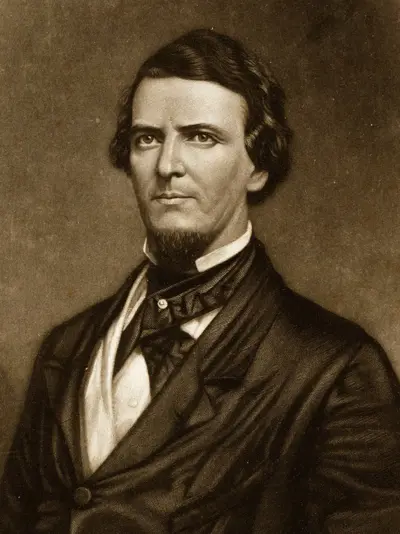
Preston Smith Brooks was an American politician and Member of the U.S. House of Representatives from South Carolina, serving from 1853 until his resignation in July 1856 and again from August 1856 until his death.
