Preston Brooks Quotes
I should have forfeited my own self-respect, and perhaps the good opinion of my countrymen, if I had failed to resent such an injury by calling the offender in question to a personal account.
Brooks, Preston S. "Personal Explanation—Speech of Hon. P. S. Brooks, of South Carolina, in the House of Representatives, July 14, 1856." Appendix to the Congressional Globe, 34th Congress, 1st Session, John C. Rives, 1856, p. 831.


This quotation is sometimes misunderstood by Westerners as implying that abstract justice is not as important as practical achievements. However, to the Bedouin, as to most Arab cultures, abstract justice is extremely important—as is reputation. The Western translation might be: “Don’t confuse getting justice with achieving material gain. Often you may not gain anything material, but you still must maintain your honor or reputation. This notion, as many Arab ideas, starts out as applying to individuals, and then generalize to families, clans, tribes, nations, and even Islam as a whole.

In the lowest point in Senate history, Senator Brooks snuck up behind Senator Charles Sumner, stuck Sumner a massive blow to the back of the head with a heavy stick. While Sumner was half conscious and caught in his desk, Brooks continued to beat Sumner senseless. Sumner did not die but was seriously handicapped for life. Preston attacked Sumner supposedly because Sumner made a senate speech condemning slavery practices in South Carolina and “insulted” Brooks’ cousin—a Congressman who was defending slavery. Because of the polarization between North and Southern senators, no resolution could be passed to condemn and discipline Brooks so the Senate became the only place in America where someone could beat an unarmed, defenseless man senselessly with impunity. Even some Southerners were surprised because at that time “Gentlemen” still fought duels over disputes and in those, both parties would be equally armed.

This proverb only makes sense in the light of understanding the Arab concept of revenge—“blood.” In a rural desert environment where little can be expected of government, the Arabs have developed a law enforcement and peace keeping mechanism which while primitive from modern standards, nevertheless worked to some degree. It is that revenge—“blood” is a moral necessity and obligation of all people, and revenge is not limited by time or to the individuals involved in the first incidence. The immediate family are the first to extract revenge, but the extended family follows and often the entire clan. Sometimes revenge is tribal or even national. Anyone who fails to revenge a member in his group is not only a disgrace, but is a clear and present danger to the group because then they can be attacked with impunity. So revenge is a strong obligation of the group members and blood must be paid with blood no matter how many generations it may take. The only thing that keeps me and my family safe, is the surety what whosoever kills one of us will themselves be killed or if they die a natural death we will take revenge on one of the evildoers relatives. Crime must never pay!


Russert was so angry at the Sept. 11 attack that he felt he could not maintain objectivity in reporting regarding what America’s response ought to be. Like Pearl Harbor, almost all Americans were outraged. There were probably few American journalists who did not feel anger, but with Russert’s high standards of journalistic integrity he worried about it more and expressed his concern. Ironically, in the aftermath of Sept. 11, the American press & media tended not to examine administration responses with their normal cynicism and suspicion. At the time, George W, Bush, one of America’s poorest Presidents was in office, and before the media and the public looked into all the administration’s actions, the United States had gotten into what turned out to be a series of foreign policy and military quagmires, and had given $ billions worth of contracts to companies associated with the Vice President, the President’s family and others. Much of the money was never found or justified.
This proverb only makes sense in the light of understanding the Arab concept of revenge—“blood.” In a rural desert environment where little can be expected of government, the Arabs have developed a law enforcement and peace keeping mechanism which while primitive from modern standards, nevertheless worked to some degree. It is that revenge—“blood” is a moral necessity and obligation of all people, and revenge is not limited by time or to the individuals involved in the first incidence. The immediate family are the first to extract revenge, but the extended family follows and often the entire clan. Sometimes revenge is tribal or even national. Anyone who fails to revenge a member in his group is not only a disgrace, but is a clear and present danger to the group because then they can be attacked with impunity. So revenge is a strong obligation of the group members and blood must be paid with blood no matter how many generations it may take. The only thing that keeps me and my family safe, is the surety what whosoever kills one of us will themselves be killed or if they die a natural death we will take revenge on one of the evildoers relatives. Crime must never pay!


Samuel Langhorne Clemens, 1835-1910

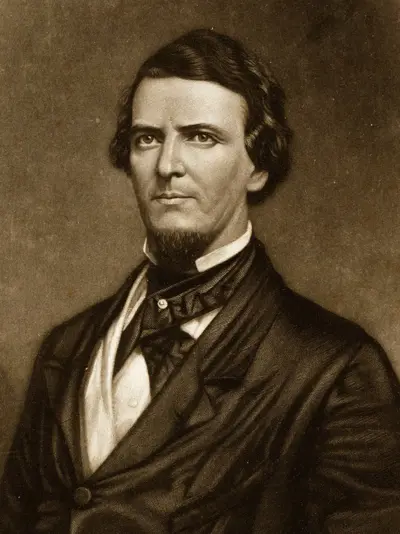
Preston Smith Brooks was an American politician and Member of the U.S. House of Representatives from South Carolina, serving from 1853 until his resignation in July 1856 and again from August 1856 until his death.
