NEW YORK TRIBUNE
(New-York Tribune)
In 1856 Senator Charles Sumner, a strong slavery opponent, was writing at his Senate desk and a Southern Congressman, Preston Brooks, sneaked up behind him and beat him senseless with a heavy cane. The beating shocked most of the country and ended much of the comity between pro-slavery and anti-slavery members of Congress. Sumner was in treatment and therapy for 3 years, but returned to the Senate to be one of the radical Republican abolitionists who pressured Lincoln on the emancipation issue and led the vigorous Reconstruction efforts after the war. For the northern newspapers, this became the symbol of Southern lack of civilization and fanaticism which did as much as anything to set the stage for the Civil War. A majority of the House of Representatives voted to expel Brooks, but the necessary two-thirds could not be obtained because Southerners supported Brooks creating even more division between North and South. Brooks was so shunned however that he shortly resigned.
This cry echoed throughout the North where the public wanted a full invasion of the capital of the Confederacy to put an end to the rebellion. However is was not clear what effect that would have on the Border States—Maryland and Kentuucky—and many politicians thought that the South would “come to its senses” once they realized what they had done. But the South would not change its course, and the Union Generals in Command were very reluctant to actually invade the South. It was only after the South attacked in the North that the Union Military began to realize that this was a Civil War that would not be resolved politically.
The “rat killing” was a standard sport of the time. The custom was to match two men and two dogs against one hundred rats. Wagers were made on the time it took to kill the rats.
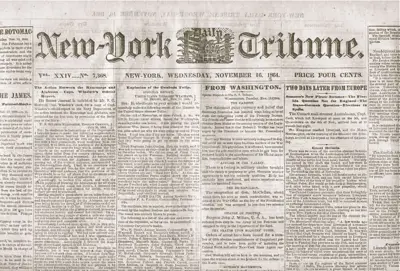
The New-York Tribune was an American newspaper, first established in 1841 by editor Horace Greeley. Between 1842 and 1866, the newspaper bore the name New-York Daily Tribune. From the 1840s through the 1860s it was the dominant Whig Party and then Republican newspaper in the United States. The paper achieved a circulation of approximately 200,000 in the 1850s, making it the largest daily paper then in New York City. The Tribune's editorials were widely read, shared, and copied in other city newspapers, helping to shape national U.S. opinion. It was one of the first papers in the north to send reporters, correspondents, and illustrators to cover the campaigns of the American Civil War.
