New York Tribune Quotes
It is a remarkable fact that the slave-traders in this city have matured their arrangements so thoroughly that they almost invariably manage to elude the meshes of the law. Now they bribe a jury, another time their counsel or agents spirit away a vital witness...The Government is determined to break up the African slave-trade, and it will accompllish it. To effect this it will be necessary to purge the Courts and offices of these pimps of piracy.
New York Tribune Editorial, 1860, Quoted in Smithsonian, 2007
Sourced by: Eigen's Political and Historical Quotations


The highest court in New York.

American reformers followed slavery issues in Africa and elsewhere. The status of Africa was particularly important as the notion of extensive American Black colonization was still viable to many.

Nathaniel Gordon was the first American slave trader to be executed after the slave trade was made illegal. The Erie was his slave ship where, as was typical, many of the captured Blacks, died as a result of the inhuman conditions. Although Gordon was the first person executed in America, the act making the slave trade an act of piracy dated from 1820. See {68753} .
This quotation sheds light on an embarrassing aspect of corruption in the Union Army during the Civil War. Captain Wilder was as his official title denotes, the officer on his military base in charge of slaves who had escaped and crossed over the Union Lines. Escaped slaves were officially called “Contrabands.” He had over 10,000 in his charge. There had been an official order issued by the General of the Army that prohibited the military from returning slaves to their owners. See {619337}. However, the Southern owners of the escaped slaves would cross the Union lines, go onto the Union military base, identify their former slaves, at Fort Monroe, and bribe Union soldiers to in effect kidnap the former slaves and forcibly return them to their former masters. Then, often using bribery, the masters would smuggle their former slaves back across the lines and return to their plantation where the escapees were physically punished and put back to work. While some Union military commanders would not allow this, others thought the action just and was a good way for the men to pick up some extra money. The photo was taken in the Captain’s district showing the runaway slaves in work details for the army.


He was also himself a ship owner in the slave trade and he was the brother of the leading Rhode Island abolitionist, Moses Brown. See {585793}. Brown became the first American, prosecuted in federal court for illegal slave trading –-- a prosecution brought, in part, by his own brother. He was, however, acquitted.

After the civil war there was a concerted effort to shape American opinion away from the notion that the Civil War has mainly about slavery which we now know was a false notion. Slavery was the only significant issue for both sides. This quotation is cited by many who argue that the prospect of the end of slavery was tantamount to economic confiscation and impoverishment for the slave owning minority and hence it drove them to rebellion. Also, Davis and others argue that the value of the slaves was so great that there was no possible economic way to compensate the slave owners for emancipation at fair market value which was why that “compromise” never went anywhere.


The bill was defeated in the Confederate Senate {590064} so was the last good opportunity for the Confederacy. Lee was totally correct about what the Union would do, and the Northern use of Negro troops from the South was the final nail in the Confederate coffin.

The British Consul was attempting to implement the British government’s new anti-slavery policy.

This was one of the first steps to ending of slavery in England. The council passed a number of general reforms from this to the prohibition of the clergy frequenting ale houses.

Southern secession and the Civil War This is one of the major quotations with which historians rebut the revisionist view that the Civil War was about States’ Rights or other economic factors.


The general issued a military order emancipating slaves in Florida, Georgia and South Carolina. President Abraham Lincoln rescinded the order feeling it was too premature and it would cause the slave states that stayed in the Union--Delaware, Maryland, and Kentucky--to go over to the Confederates.

One of the first anti-slavery formal resolutions in America.

Fitzhugh was a Southern iconoclast whose view of Northern labor was much like that of Karl Marx but who was an enthusiastic supporter of slavery. Fitzhugh was of the opinion that slavery would be reinstated in the North and his treatise agues for that. More and more intellectual opinion was coming to the conclusion that slavery must be abolished or made universal before Lincoln’s famous statement in his debate against Douglas. Although Northerners and Southerners had come to agree on this point, they disagreed about which alternative would and should prevail.

The country had been completely polarized by 1854. It was only a matter of time for something like the Civil War to break out. The impossibility of compromise was not just held by radicals like Garrison but after the Compromise of 1850 fell apart, most politicians on both sides s
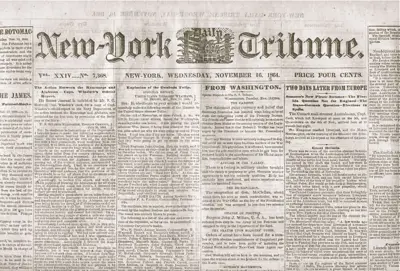
The New-York Tribune was an American newspaper, first established in 1841 by editor Horace Greeley. Between 1842 and 1866, the newspaper bore the name New-York Daily Tribune. From the 1840s through the 1860s it was the dominant Whig Party and then Republican newspaper in the United States. The paper achieved a circulation of approximately 200,000 in the 1850s, making it the largest daily paper then in New York City. The Tribune's editorials were widely read, shared, and copied in other city newspapers, helping to shape national U.S. opinion. It was one of the first papers in the north to send reporters, correspondents, and illustrators to cover the campaigns of the American Civil War.
