Mao Zedong Quotes
Our enemies are all those in league with imperialism -- the warlords, the bureaucrats, the comprador class, the big landlord class and the reactionary section of the intelligentsia attached to them…. As for the vacillating middle bourgeoisie, their right-wing may become our enemy and their left-wing may become our friend -- but we must be constantly on our guard and not let them create confusion within our ranks.
Mao Tse-Tung, 1893-1976, Chairman, Communist Party, China, Analysis Of The Classes In Chinese Society, March 1926
Sourced by: Eigen's Political and Historical Quotations

The non-communist forces of China were always struggling with each other for power. Attempts by non-communist reformers were defeated by autocrats, warlords, major landlords, and various religions organizations and denominations which were all fighting each other.


Indeed, that is just what happened. The Fascists were seen by the Government as preferable to the left wingers. The fascist rebels were soon fighting with the establishment monarchists against the Republicans.


Vladimir Lenin
The occasion for the speech was the 60th birthday of Russian Premier, Joseph Stalin.
In 1927 there was a Peasant Uprising in the Hunan Province of China. Young Mau went there and wrote a report. Mao and other young communist leaders had a much more acute appreciation of sloganeering than their older revolutionary comrades. Even into the 3rd millennium, the same “Down with Imperialism” slogan could be heard in many part of the world, long after the Soviet Union collapsed and China and become capitalistic.

After the 1917 Russian Revolution many of the Western Countries sent troops to Russia where they aided the Whites against the Reds. When the Red Bolsheviks prevailed, there were many attempts to diplomatically and economically undermine the Communist government. This caused a unity among different Russian factions. Sforza urged leaving them alone and letting the Bolsheviks fail by their own ideology. Most Western nations and the United States did not agree with him.


He moved to the U. S. after these events.


He had asked a family friend not to bring books by Hemmingway into his home. The friend asked why and received this answer. Koch and his brother were the largest political contributors in the United States, so they had enormous influence on Republicans (they only made political contributions to conservative organizations).


The word “smashing” is a literal translation from the Khmer language. It is not used in the metaphorical sense as we are used to. To save money, arms, bullets and resources the Khmer Rouge method of execution was to “smash” the victim’s head in with a shovel or other implement. This slogan told people literally to murder their political enemies in this brutal way.

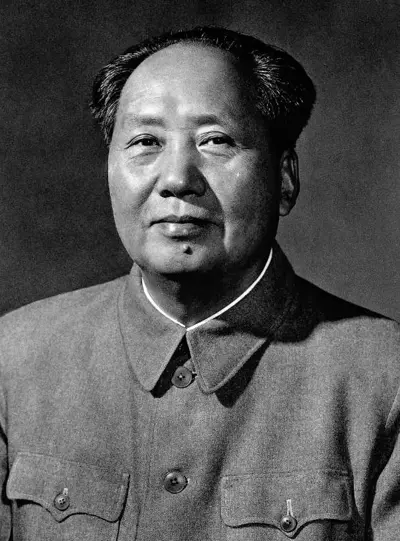
Mao Zedong, also known as Chairman Mao, was a Chinese communist revolutionary who was the founder of the People's Republic of China (PRC), which he ruled as the chairman of the Chinese Communist Party from its establishment in 1949 until his death in 1976. Ideologically a Marxist–Leninist, his theories, military strategies, and political policies are collectively known as Maoism.
