John F. Kennedy Quotes
Communism has never come to power in a country that was not disrupted by war or corruption, or both.”
John F. Kennedy, 1917-1963, 35th President of the United States (Democrat, MA), The uncommon wisdom of JFK: a portrait in his own words (2003 edition)
Sourced by: Eigen's Political and Historical Quotations


Commenting on political parties in Cuba:

The non-communist forces of China were always struggling with each other for power. Attempts by non-communist reformers were defeated by autocrats, warlords, major landlords, and various religions organizations and denominations which were all fighting each other.


He was one of the early predictors of the fall of the Soviet Union. See {586209} for part of his reasoning.


The letter was widely published. There were few left wing intellectuals who would take Lenin on at the time but Gorter was one. The immediate quotation shredded a brochure that Lenin had produced for world wide communism where he was critical of other left wing movements.


The Second World War placed German Communists in a dilemma. The capitalistic democracies had been an enemy of communism, but the worst enemy was Fascism and there was nothing worse than German Fascism who victimized the German communists. Therefore, the democracies were not to be regarded as the enemy of German or world communism.
And as the leader of the exploited, after his revolution he became a dictator himself, albeit a very popular one amongst most Cubans.


In 1927 there was a Peasant Uprising in the Hunan Province of China. Young Mau went there and wrote a report. Corruption has plagued China for millennia. As can be seen by this quotation, Mao thought that a “people’s revolution” would end corruption and despite capital punishment for corruption under the Communist government, corruption still thrived. By the 21st century corruption was common among local Communist Party Officials despite national party and government attempts to obliterate it.


After the 1917 Russian Revolution many of the Western Countries sent troops to Russia where they aided the Whites against the Reds. When the Red Bolsheviks prevailed, there were many attempts to diplomatically and economically undermine the Communist government. This caused a unity among different Russian factions. Sforza urged leaving them alone and letting the Bolsheviks fail by their own ideology. Most Western nations and the United States did not agree with him.


Unlike most of his televangelist successors, Sheen was very ecumenical. He was clearly Catholic but had a very significant Protestant and Jewish Audience.

Socialism in its then pure form had the state owning and controlling all the major assets of the nation. In this sense it was contradictory to individual freedom and hence democracy. However, in the years after Tocqueville’s quotation and the industrial revolution, socialism has gradually moved away from state ownership and operations of all institutions and resources. Democracy has tended to adopt a more regulatory view to control the excesses of unbridled capitalism. The range of democratic nations by the 21st century encompassed differences but some were described as “social democracies” and had some state ownership but were basically capitalistic economies. Even the self-described Communist nations had become heavily capitalistic albeit with less political freedom. At the same time, even the United States—the epitome of 21st century capitalism, owned and controlled a few of the resources and means of production and tended to regulate the others—a substantial difference from the American democracy which Tocqueville studied.


Francisco Ascaso, Buenaventura Durruti, Juan Garcia Oliver, Aurelio Fernandez, Ricardo Sanz, Gregorio Jover, Antonio Ortiz and Antonio Martinez "Valencia
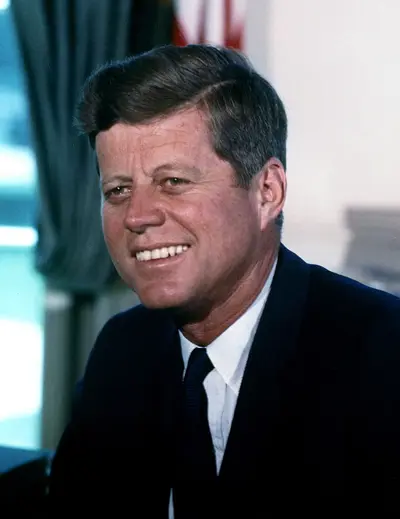
John Fitzgerald Kennedy, often referred to by his initials JFK, was an American politician who served as the 35th president of the United States from 1961 until his assassination in 1963. Kennedy served at the height of the Cold War, and the majority of his work as president concerned relations with the Soviet Union and Cuba. A Democrat, Kennedy represented Massachusetts in both houses of the U.S. Congress prior to becoming president.
